

Did you know that choosing the correct welding equipment can transform your welding productivity, weld quality, and overall project cost?
While pipe welding and tank welding both join pieces of metal, they require different methods, workstations, and equipment.
Ignoring the use of the right machines and positioning systems can affect your work speed and increase the chances of welding defects.
If you work in the oil and gas industry, construction, shipbuilding, power plants, or manufacturing, you need to have a good understanding of both systems.
It will help you make smarter investment choices when setting up the equipment for your industry. Let us explain both pipe welding and tank welding methods with their differences.
What Is Pipe Welding?
Pipe welding is a method that helps you connect two or more metal pipes together with the help of strong, durable, and leak-proof bonds. In industrial systems, it is a dangerous task to transport steam, liquids, gases, and even chemicals in welded pipes.
These substances often have to travel under high pressure or elevated temperatures. Because of this, every single weld must pass through thorough quality inspection. Even the smallest defect can result in leaks, costly outages, or equipment failure.
Below are some common industries that utilize pipe welding:
- Oil and Gas
- Petrochemical
- Power Generation
- Water Treatment
- Pharmaceuticals
- Food Processing
- HVAC Systems
- Fire Protection Systems
All of these industries depend on reliable pipe welds to ensure safe and efficient operations. Pipe welding is quite different from welding flat metal plates for many reasons.
Unlike flat joints, welders must work on circular joints when welding pipes. This means that welding must be done in a variety of positions like horizontal, vertical, inclined, even overhead.
Most of the time, the pipes are installed in extremely restrictive spaces that don’t allow a lot of movement. Hence, this makes the welding task even more challenging. Many fabrication shops enhance efficiency and weld quality with specialized tools like welding manipulators, pipe rollers, and welding positioners.
With the help of such machines, you can position and rotate the pipe to weld in a comfortable position. This cuts down operator fatigue and helps improve the quality and consistency of the welds.
There are several different weld processes that can be used to fabricate pipes:
- TIG (GTAW): This is a process that is often used when welds need to be very precise. It is done on stainless steel.
- MIG (GMAW): It is a process that is done when faster weld production is required.
- Stick welding (SMAW): It is a process that is most often used for welds at field installations. It is very versatile.
- Flux-Cored Arc Welding (FCAW): It is a process that is done when a high deposition rate is needed for heavy-duty welds.
- Submerged Arc Welding (SAW): It is a process that is used for large industrial pipes as it offers deep weld penetration and high productivity.
The selection of a suitable weld process is dependent on the pipe material, wall thickness, project specifications, and the volume of production.
What Is Tank Welding?
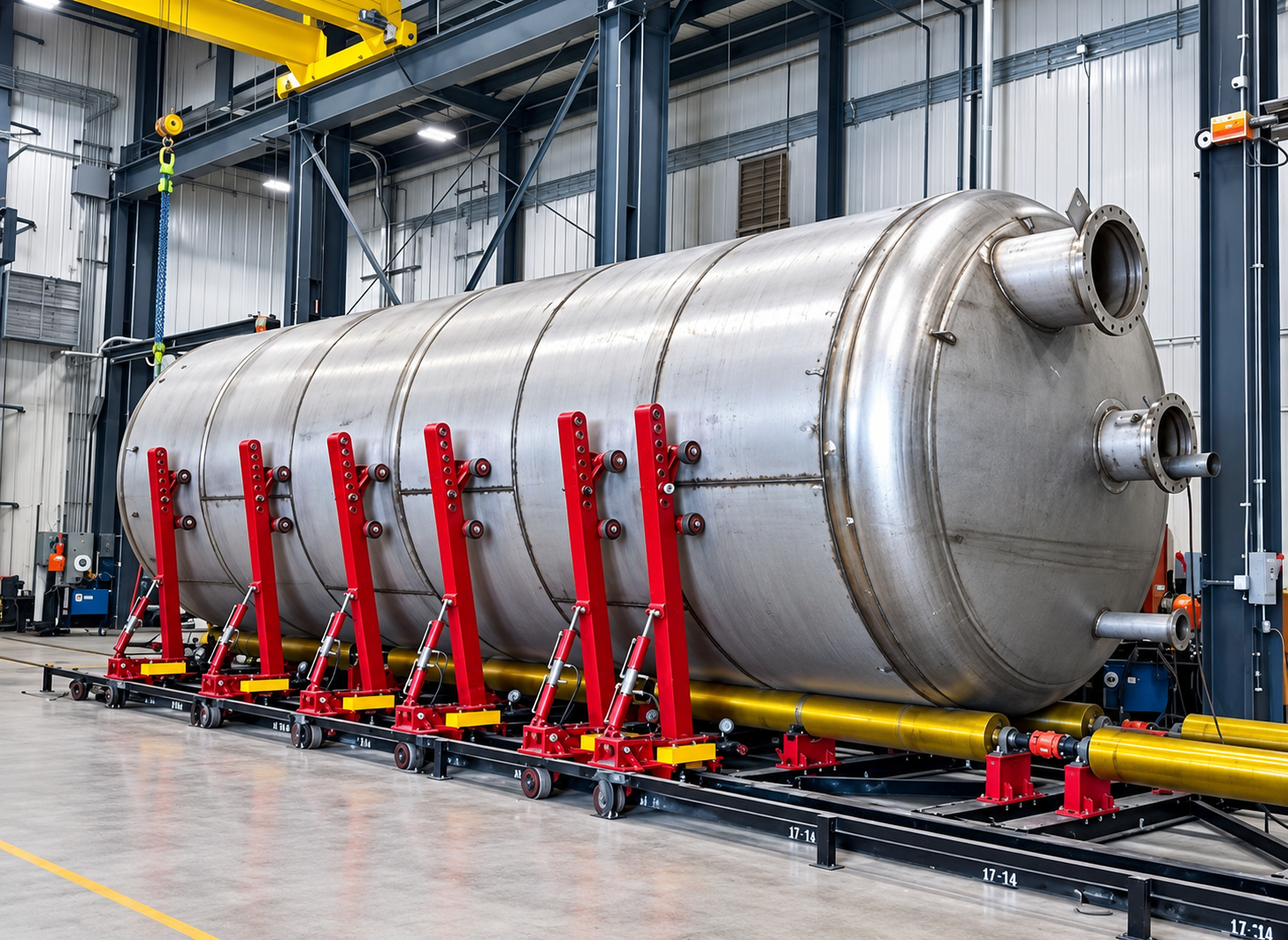
Tank welding is a process that involves the fabrication, assembly, or repair of large containers for industrial use. Examples of these containers include large storage tanks, pressure vessels, silos, and industrial reactors.
These containers are needed for the safe storage and transport of liquids, gases, chemicals, and other materials. Hence, effective tank welding with strong and reliable welds is essential as it impacts the durability, safety, and performance of the containers.
Many storage tanks, pressure vessels, silos, and reactors contain hazardous substances or operate under pressure. A small welding defect can cause leaks, contamination, and even expensive tank repairs. Tank welding is inherently different from pipe welding.
Pipe welding requires the joining of small, cylindrical pipes, whereas tank welding requires the joining of large, steel plates into cylindrical, spherical, or custom-shaped vessels.
The steel workpieces are massive and can weigh many tonnes. Hence, you have to be extra careful even when you are handling and positioning the workpieces.
Tank welding is widely used in various industries including:
- Oil storage
- Chemical processing
- LNG terminals
- Water treatment and storage
- Food Manufacturing
- Pharmaceutical Plants
- Minning
- Shipbuilding
- Marine engineering.
These industries need tanks with good quality welds in order to ensure safe storage, efficient operations, and compliance with various industrial regulations.
Tank welding requires long, even, and continuous welds over a desired length, while ensuring consistency remains a challenge. It is not practical to manually rotate or reposition a tank of that size.
Manufacturers therefore resort to various kinds of equipment, such as:
- Welding rotators
- Tank welding rotators
- Welding manipulators
- Column-and-boom systems
This equipment assists in the rotation of the tank or positioning of the welding torch, and results in a smoother and more precise weld with less physical effort.
By automating tank welding, you can lower manual handling and improve weld consistency. Continuous tank welding, as a result, improves productivity, safety in the workplace, and product quality.
Pipe Welding vs Tank Welding
You can use both pipe and tank welding to join metals and create strong structures. However, you must acknowledge that both have different purposes; hence, they require different equipment. Their workpiece sizes, welding methods, automation, and production processes are completely different.
By having a good understanding of these differences, you can choose the most suitable welding method for your project. Here are some key differences between pipe welding and tank welding.
1. Workpiece Size and Structure
One of the most important differences between pipe and tank welding is that their workpieces vary in size. You can use pipe welding to join small cylindrical pipes and tubes. These pipes can be in the range of a few inches to several feet in diameter. There are some industrial pipes that are quite larger than this range.
However, they are still smaller than storage tanks and pressure vessels, making their handling easier. On the other hand, tank welding is designed to handle massive steel structures. You can use it to weld storage tanks, silos, reactors, boilers, and pressure vessels. Such structures can easily weigh several tons or even hundreds of tons.
Their size and weight demand equipment that can handle heavy-duty structures during the welding process. So, if you are working on pipelines, you need equipment that guarantees precision. However, if you are welding large tanks, you must aim for equipment that can support heavy loads.
2. Welding Position and Complexity
Another key difference between pipe and tank welding is the welding position. When pipe welding, you need to weld around a circular joint. It depends on how the pipe is installed. You will have to position the welding arc horizontally, vertically, overhead, or at an angle in order to weld pipes.
The varying welding positions make pipe welding a very technically demanding welding application. To help overcome issues like operator fatigue and ensure consistent welds, welders often turn towards welding positioners or pipe rollers. These rotate the pipes, allowing you to work in a comfortable welding position. Tank welding comes with a challenge of its own.
Since tanks are large in size, it is nearly impossible for welders to manually reposition them while welding. Hence, they use welding rotators to slowly rotate the workpieces instead of moving the torch. Using this set-up, welders are able to weld complete long welds without changing their positions again and again.
3. Weld Length and Consistency
Another difference is the length of the weld. For pipe welding, you only need short circular welds which are placed around the pipe joint. Despite being short, they require utmost precision as they have to carry pressurized fluids or gases. A single small defect can cause the entire system to fail due to leakage. However, tank welding demands longer weld seams.
You have to place longitudinal welds as well as circumferential welds. This means you cover the length as well as the diameter. Hence, you must ensure consistent weld penetration along the entire distance. This can be accomplished with the help of excellent equipment stability and precise control. Hence, automated welding systems are commonly seen in tank welding.
4. Equipment Requirements
Pipe welding and tank welding both have their own specific equipment. Pipe welding demands precision and correct positioning. Hence, pipe welders use welding positioners, pipe rollers, fit-up equipment, orbital welding systems, and welding manipulators. These systems help ensure alignment, support, and easy rotation.
So, you can achieve high-quality welds without a lot of manual effort. On the other hand, tank welding requires equipment that can bear the load of heavy workpieces. Welders use welding rotators to support and rotate large tanks while welding.
There are welding manipulators as well as column-and-boom systems as well. These can help ensure precise positioning of the welding head. Hence, these machines help improve efficiency and reduce operator fatigue. With these, consistent tank welds can be achieved.
5. Level of Automation
Nowadays, industries are moving towards automation. However, the extent of automation varies for tank and pipe welding. High-precision repetitive pipe welding can be performed on semi-automatic or fully automatic systems for industries like pharmaceuticals and food processing. An example of this is orbital welding.
This process produces consistent welds on stainless steel pipes without much operator involvement. For tank welding, you can opt for a much higher level of automation. This is because tanks are large; hence, they demand a much longer weld seam. By automating the setup, you can improve the productivity of your workflow along with lowering labor costs.
Welding rotators, manipulators, automatic seam trackers, and programmable control systems can easily work in collaboration to offer you smooth, consistent welds over long distances. Automation can be very helpful in improving efficiency and reducing rework if your business manages large-scale production.
6. Pipe Welding Requires Precision
Pipe welding is more focused on the accuracy of welds. Before you begin the process, you must ensure correct alignment of the pipe sections. This will guarantee a good fit as well as a uniform root gap. A slight misalignment can lead to weakening of the joint. Weak joints often leak when the pipeline is in service.
To achieve a better level of precision, welders use welding positioners, pipe rollers, and fit-up equipment. With the help of these tools, you can easily rotate and align the pipe. Therefore, it becomes easier for you to maintain an ideal welding angle throughout the welding process. As a result, your welds get better penetration, making them clean and consistent.
7. Tank Welding Prioritizes Stability
Tank welding is more focused on stability rather than precision. Large tanks are too big to be rotated or repositioned manually. However, you still need to maintain a smooth, controlled movement. Hence, you need welding rotators which are designed to support the weight of the tank.
These rotators keep the tank rotating at a constant speed. This enables your welding torch to travel evenly along the joint. By ensuring a stable movement, you can easily maintain uniform weld penetration. This will lower the chances of welding defects. Furthermore, the appearance of the weld will also improve.
With automated rotation, you can lower operator fatigue without compromising productivity. As a result, you create a safe and efficient working environment.
Here is a table to help you analyse the key differences between pipe and tank welding.
|
Welding Equipment for Pipe Welding
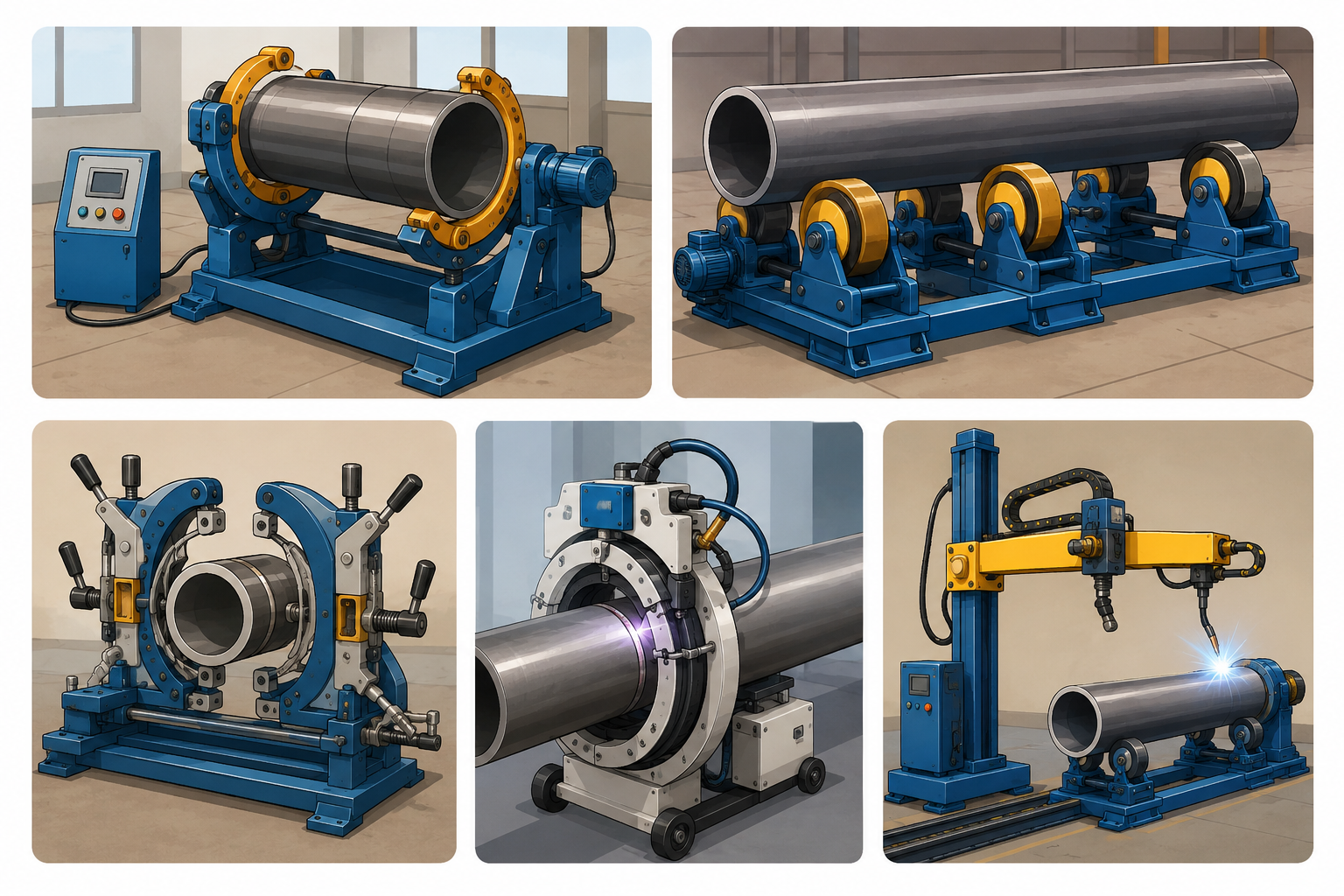
Most people assume that a welding machine alone is sufficient for welding processes. In reality, the efficiency of your operation depends on the supporting equipment used. For pipe fabrication, you need equipment that allows precise positioning and smooth rotation.
Below are some commonly used pipe welding equipment.
1. Welding Positioner
A welding positioner rotates and tilts the workpiece, making welding more convenient and comfortable. So, when the equipment rotates the pipe, you don’t have to move around it. This helps minimise operator fatigue.
The benefits include:
- Better weld quality
- Faster production
- Reduced welder fatigue
- Improved safety
- Consistent welding speed
For welding small and medium-sized pipes, flanges, fittings and other fabricated components, you can also use positioners.
2. Pipe Rollers
Pipe rollers have to withstand the weight of long pipes during fabrication. They provide the pipes with smooth rotation while preventing them from bending or vibrating. They are essential when it comes to long pipeline sections and heavy industrial piping.
3. Pipe Fit-Up Equipment
You must ensure proper pipe alignment before welding begins. Hence, pipe fit-up equipment helps in lining pipe ends accurately. They ensure that the root gap variation is minimal. This helps prevent defects. Pipeline construction and fabrication shops most commonly use this type of equipment.
4. Orbital Welding Systems
Orbital welding systems are used when precision is crucial, for example in pharmaceutical or food-grade piping. These machines can provide you with highly repeatable welds automatically. This helps minimise operator fatigue. They are most commonly required for stainless steel and hygienic piping systems.
5. Welding Manipulator
A welding manipulator holds and moves the welding torch in one place while the pipe keeps rotating. It makes sure that the torch is in a steady position throughout the process. So, you don’t have to manually control the movement. This setup enhances the consistency and is useful for repetitive production.
Welding Equipment for Tank Welding
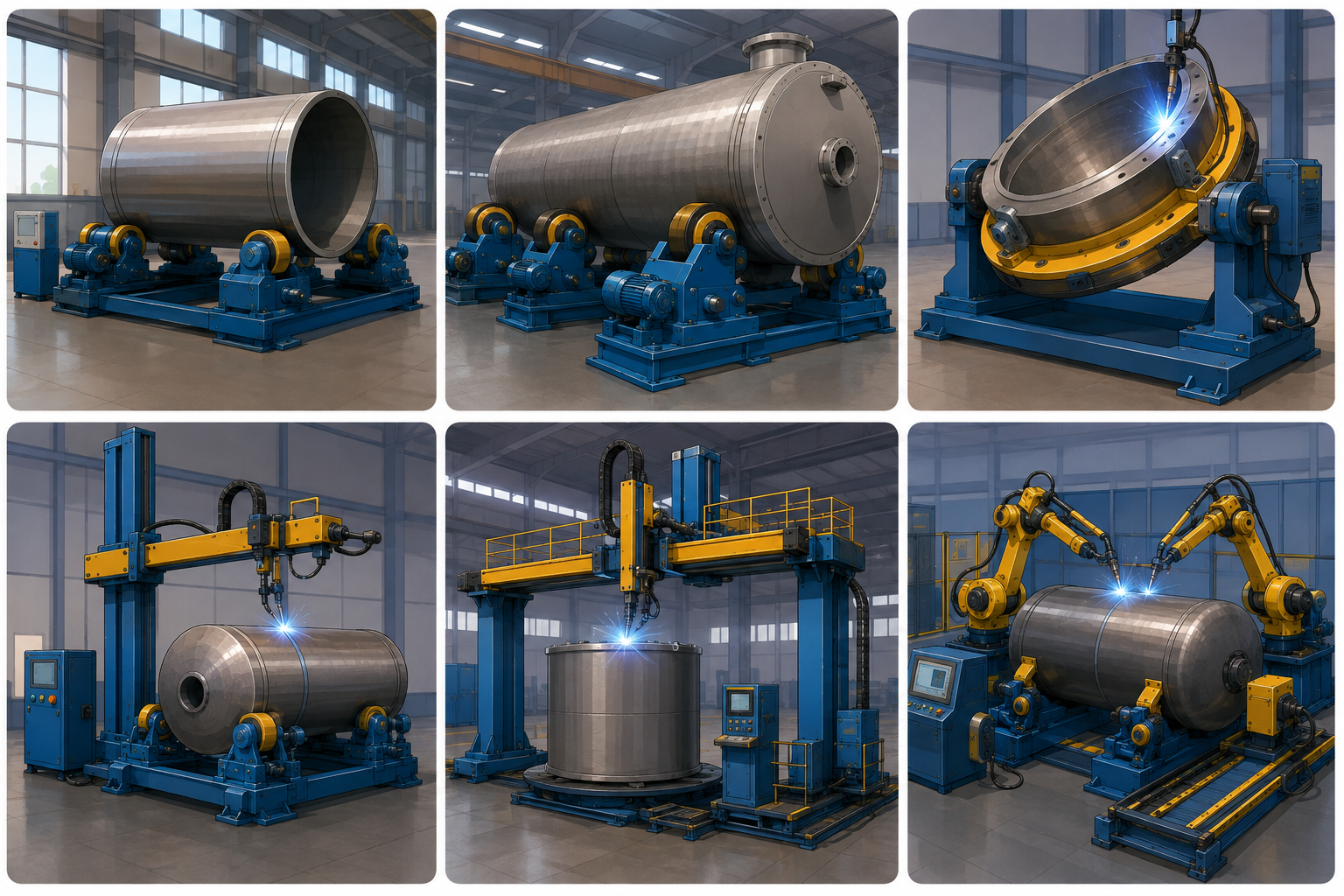
Welding a tank means working with heavy pieces that cannot be moved manually. Instead of moving the welder around the tank, a machine positions and rotates the tank. This allows the welders to have an ideal angle for more efficient tank welding. This improves weld quality, reduces fatigue, and also improves the efficiency of the production line.
Let us explain the main types of tank welding equipment.
1. Welding Rotator
A welding rotator is an important piece of equipment for tank welding. A welding rotator consists of powered and idle rollers that support and rotate cylindrical workpieces. Instead of manually turning a heavy tank, the rotator turns it for you at a controlled speed so you can weld. This allows you to perform long welds with a high level of accuracy and consistency.
The oil and gas industry, pressure vessel fabrication, and ship construction are some of the industries that use welding rotators the most to improve efficiency.
The benefits include:
- Increased operator control over rotating cylinders
- Enhanced tank weld appearance
- Decreased time needed to perform each weld
- Decreased operator fatigue
- Increased productivity
- Increased safety for employees and surrounding personnel
2. Tank Welding Rotator
A tank welding rotator is mainly used to weld big-capacity tanks and pressure vessels. These are not like regular rotators. They are designed for much heavier loads and bigger diameters. Some of them also have self-aligning rollers which automatically adapt to various tank sizes.
This helps you save time that is usually wasted on setting up. If you manufacture tanks regularly, investing in an industrial tank welding rotator would help increase your manufacturing capacity.
The benefits include:
- Handles extremely heavy tanks
- Maintains stable rotation
- Suitable for large-diameter vessels
- Improves weld consistency
- Reduces crane usage during welding.
3. Welding Positioner
While welding positioners are often used for pipes, they can also be used to weld tanks. Smaller tank parts like nozzles, flanges, support brackets, and manways are usually welded individually, then attached to a larger tank. A positioner rotates these smaller components into the ideal welding position.
The benefits include:
- Produces higher-quality welds
- Reduces repositioning time
- Improves operator comfort
- Supports precise welding
4. Welding Manipulator
A welding manipulator holds the welding head while maintaining precision as the workpiece rotates. It consists of a vertical column and a horizontal boom, which lets the welding torch move in different directions.
Used along with a welding rotator, the manipulator creates an automated system that makes welding more efficient and convenient. You can spot large fabrication shops using manipulators for pressure vessels, wind towers, boilers, and storage tanks.
The benefits include:
- Consistent torch angle
- Accurate weld placement
- Reduced manual effort
- Improved repeatability
- Ideal for long weld seams
5. Column and Boom Welding System
A column and boom system is an advanced type of machinery designed for large industrial projects. The machine moves the welding head to its most ideal position. This eliminates the need for the operator to move around the tank.
This setup is commonly used for submerged arc welding (SAW), especially when working with thick steel plates.
The common applications include:
- Storage tanks
- Pressure vessels
- Wind towers
- Boilers
- Offshore structures
6. Automatic Welding Systems
Nowadays, tank welding machines are moving towards automated systems to make welding more efficient. Various automatic welding equipment such as welding rotators, manipulators, sensors, and programmable controls work together. These systems help produce high-quality welds while reducing the amount of human intervention.
Automation saves money and time for companies that make tanks in bulk quantity.
The benefits include:
- Faster production
- Better weld consistency
- Lower labor costs
- Reduced rework
- Improved quality control
How to Choose the Right Welding EquipmentThe type of equipment you must select is entirely dependent on what your project needs. However, you shouldn’t just go for the most expensive or the largest machine. The best thing is to understand what system or equipment can help improve the workflow and offer you the best results. Below are some tips to help you make the right decision. 1. Consider the Type of WorkpieceTo start, consider what you are welding. Are you welding pipelines or storage tanks? Usually, if you are fabricating pipelines, structural tubing, or pipe spools, then pipe welding equipment with rollers and positioners is the right selection. However, for fabricating storage tanks or pressure vessels, welding manipulators and welding rotators may be the right choice. 2. Evaluate the Workpiece Size and WeightEvery machine has a finite capacity. Before making a purchase, consider the following for each piece:
Selecting equipment with insufficient capacity can actually be a safety issue. It can also cause economic issues by reducing the machine’s life. Always ensure that you have a decent margin for future project needs. 3. Think About Production VolumeIf you do welding work occasionally, manual equipment will be enough for you. However, if your work involves handling dozens of similar projects again and again, then you can opt for automation. This will increase your productivity by reducing losses due to machine downtime. It will provide you with greater precision and consistency, helping you meet strict deadlines. 4. Match the Equipment to Your Welding ProcessJust like other aspects of welding, different equipment is required for different processes. TIG welding offers utmost control and precision; hence, it is the method of choice for welding thin-walled pipes and stainless steel. MIG welding is considered the general method for fabrication because of its high speed. For thick steel, Submerged Arc Welding (SAW) is the best as it offers high deposition rate and deep penetration. Always remember, your welding equipment must be compatible with your selected welding process. 5. Consider Future ExpansionYou must think beyond your current projects. If you want your business to expand, you must choose the equipment wisely. You may need equipment that can support various workpiece sizes. Keep in mind that automation should also be easily supported by your equipment. Opting for a setup that supports a range of automation can save you from spending money later on when you need to upgrade. 6. Prioritize Safety and ErgonomicsIf you have good welding equipment, you not only improve your productivity but also ensure the safety of your workers. Having features such as controlled rotation, remote operation, overload protection, and stable support minimizes operator fatigue as well as the chances of an accident occurring. By investing in an ergonomic design for your equipment, you create a safe and efficient workplace. Welding equipment can look like a tricky purchase. Hence, many welders end up making mistakes. Here are a few common ones:
|
Conclusion
You can use a similar welding process for both pipe and tank welding; however, different systems are required for optimal results. There is a higher demand for precision and exact positioning with pipe welding, while in tank welding, more emphasis is on effective movement with stability and rotation of large workpieces.
When you develop an understanding of your project requirements, production rate, and size of workpieces, you will be able to make the correct choice of equipment. It will help maximize productivity, improve quality, and enhance the safety of your work environment.
For pipe welding, a positioner in pipe fabrication is a worthwhile investment, as is a tank welding rotator for the heavier vessels. The right equipment will enable you to complete your projects more rapidly, save costs, and promote long-term growth for your business.
Frequently Asked Questions (FAQs)
1. What is the key difference between pipe welding and tank welding?
A: Pipe welding connects piping segments with the help of a circular welding seam, while tank welding is more focused on the fabrication of large storage and pressure vessels with longer seams. The weld quality, productivity, and safety of the operator can be improved with the proper positioning equipment for the particular welding task.
2. What equipment is utilized for pipe welding?
A: Positioners, pipe rollers, pipe fit-up clamps, orbital welding systems, and welding manipulators are examples of equipment used in pipe welding. These devices can help rotate, align, and hold pipes in position to make consistent and high-quality pipe welds with less manual effort.
3. In what way is a welding rotator essential for tank welding?
A: With a welding rotator, a heavy tank can be rotated with controlled speed, allowing the operator to weld continuously. The operator doesn’t have to reposition the workpiece manually from time to time. This helps improve the quality and consistency of the weld. It also reduces fatigue for the operator while increasing productivity and overall safety.
4. How do I select the welding equipment that matches my needs?
A: Size and shape of workpieces, material, volume of production, growth of business, and nature of the welding process are important considerations when purchasing welding equipment. Selecting the equipment suitable for your application not only makes operations efficient but also minimises downtime and guarantees consistent quality of welds.
5. Can one piece of equipment be utilized for both pipe and tank welding?
A: Some welding equipment can be used for both pipe welding and tank welding applications, such as welding manipulators and positioners. Tank welding uses more specialized equipment such as welding rotators. However, pipe fabrication is more focused on precision positioning and alignment equipment.
Recommend Reading
Welding Rotators for Pipe Tank Fabrication – SENLISWELD
Pipe Rotator – SENLISWELD
Welding Automation – SENLISWELD
Storage Tank fabrication – SENLISWELD
Types of Arc Welding – SENLISWELD


 EN
 ES
 RU
 JA
 FR
 PT