

One of the most important processes among the industries whose operation largely depends on robust pipelines carrying water, oil, gas, and chemicals is pipe welding.
Starting from construction sites to even oil refineries, the welding of pipes ensures these systems are strong, reliable, and safe.
This article breaks down each and every crucial aspect you will need to know, including the methods of pipe welding and their advantages to the steps involved and the potential issues that may arise with the welders.
What is Pipe Welding?
Pipe welding is one of the welding processes where long sections of pipe are welded. It is a technique where two or more pipes are joined through the action of heat and pressure to produce a powerful leak-proof joint.
It contrasts with regular welding since it often involves curved surfaces and should be done with precision techniques so that the pipes can sustain high pressure in a durable and safe manner.
Pipe welding creates a seamless joint that is not easily broken and resists extreme temperatures, high pressures, and corrosive materials. That makes it irreplaceable for the creation of pipelines to generally accepted standards that guarantee safety for the operation.
Pipe welding is one of the vital techniques in such industries dealing with oil and gas, chemical processes, construction, and plumbing, where the transportation of liquids and gases by means of pipelines is the current demand.
Main Steps Involved
Pipe welding is a type of welding that requires a systematic way of achieving good welds and joints. The key processes involved in pipe welding shall include the following:
Step 1. Preparation
- Look for any destruction, defects, or impurities in the pipe.
- It’s important to clean the surface using wire brushes or chemical cleaners to remove rust, grease, and debris for a clean weld.
- Cut and bevel edges with the help of proper cutting tools to allow pipes to correctly fit. Beveling provides good weld penetration.
- Align the pinned pipe in place by clamping or the alignment tools to maintain accuracy.
Step 2. Selection of Welding Technique
- The welding technique, be it SMAW, TIG, MIG, has a close relation with the type and thickness of pipe material and the surrounding conditions.
- Choose the best suited for your application.
Step 3. Equipment Setup
- Ensure that the calibration of the welding machine is at the required amperage and voltage for the selected process.
- Next, arrange the shielding gases, electrodes or filler metal, and protective equipment.
Step 4. Tack Welding
- Make shallow welds in several locations, fastening the pipes at the edges.
- Check for alignment and adjust accordingly before full welding.
Step 5. Welding Procedure
- The root pass forms the foundation of weld.
- Successive hot and filler passes give strength to the joint.
- Finally, complete the work with a cap pass for a neat and smooth finish; it also protects from exterior stress.
Step 6. Examination and Testing
- Visual examination of the weld to be done to check for defects such as cracks, porosity, and undercut.
- Internal quality of weld can be ascertained by the use of NDT techniques such as X-ray or ultrasonic testing.
- Check to see that the weld will meet code or project criteria.
Step 7. Cleaning and Finishing Welds
- Clean the weld area by removing slag, spatter, or any other deposit that would present a clean weld area.
- Apply coatings or treatments, as specified for corrosion protection.
Pipe Welding Advantages
Advantages of pipe welding place the practice in prime construction and maintenance of various industries due to the following reasons:
1. Strength and Durability
The welded pipes are seamless in joining. So, super strong in handling very high pressure and extreme temperature and harsh conditions. Hence, it finds its ideal applications in those places which are crucial in nature, including transporting oil, gas, and chemicals.
2. Leak-Proof Connections
Unlike the mechanical joints that had seals or threads, the welded pipes created permanent bonds. These will make sure that systems are leak-proof, reducing the possibilities of spills or other safety concerns.
3. Cost-Effective for Big Projects
Welding does not require extra parts such as flanges or couplings that reduce material costs. It is also more efficient in large projects, like pipelines, and saves time in labor.
4. Versatility in Application
Pipe welding can be applied to a wide variety of industries that range from construction and manufacturing to energy and utilities. Its adaptability to various materials, sizes, and positions makes it suitable for a wide array of projects.
5. Custom Designs
Welding allows for close work in customization since it is capable of putting pipes together in peculiar layouts or configurations that could be needed for a certain project.
6. Long-Term Reliability
That means the joints made through welding outlast those from mechanical joints, hence creating fewer needs for maintenance or replacements. The efficiency so created increases the overall efficiency of the operation and saves costs in general terms.
Pipe Welding Positions (1G, 2G, 5G, 6G)
The importance of the position of welding in pipe and pipeline welding is such that it gives what orientation or position is to be taken by the welder in approaching the joint to be welded. In this regard, positions of welding have been designated according to the relationship between the orientation of a pipe and its rotation during welding.
Familiarization with these positions will establish a fuller understanding necessary for assuring consistency in high-quality welds.

1. 1G Position (Rotated Flat)
In this position, the pipe is horizontal and also rotated to present the weld to the welder in the flat position. It is the easiest position for a beginning welder and very suitable to workshop situations where pipes can be rotated.
2. 2G Position
The pipe is then fixed in the horizontal position, and the welder has to work on the side of the pipe. Very skill-intensive as the welder needs to be constantly changing his techniques so he can return a very consistent weld. Generally used in construction and industries.
3. 5G Position
The position describes a horizontal, fixed and un-rotated pipe position. Under such an arrangement, it is expected that the welder would work around the pipe in order to make a complete weld on it. The welder has to work in most angles including overhead as well as vertical position.
This is normally used in pipeline welding, more on the field.
4. 6G Position (Inclined Fixed Position)
Pipe is set at 45-degree or inclined fixed and the welder must work on all sides, including overhead and vertical portion of pipe. It is the most Challenging of course, with greater skill and experience. Mostly used for certification tests, projects that do not allow for rotation of the pipe.
Which Welding Type is Used in Pipe and Pipeline Welding?
Many welding techniques in pipe and pipeline usually come in handy. Each technique corresponds to specific materials, project requirements, and environments. Among the most utilized varieties of welding in these applications are the following:
1. Shielded Metal Arc Welding (SMAW)

SMAW
- SMAW is also popularly known as stick welding, and it is among the most traditional but at the same time one of the most frequently used techniques to weld pipes.
- It uses a consumable electrode that is flux-covered to make the weld.
- Because of its simplicity and reliability, it works outdoors in most repair situations.
2. Gas Tungsten Arc Welding (GTAW/TIG)

TIG Welding
- This process uses a non-consumable tungsten electrode coupled with an argon-type shielding gas.
- It is an excellent way of making quality and precision welds, mainly in thin pipes and projects in which clean, smooth joints are important.
- Commonly used in food processing and similar industries due to the high concerns regarding hygiene.
3. Gas Metal Arc Welding (GMAW/MIG)

MIG Welding
- GMAW involves the continuous feeding wire electrode via a welding gun.
- Faster and easier to learn. Thus, it is quite suitable for works that are less challenging in terms of intricacy regarding pipe welding.
- Works best in a well-controlled environment due to its sensitivity to wind and moisture.
4. Flux-Cored Arc Welding (FCAW)

Flux-Cored Arc Welding
- FCAW uses a flux-cored tubular wire characterized by high productivity while being quite versatile.
- Quite good for the welding of thicker pipes and projects needing deep penetration.
- Working well for outdoors and large-scale projects, such as pipelines.
5. Submerged Arc Welding (SAW)

Submerged Arc Welding
- It has an arc buried under a layer of flux-the protection of the weld against impurities.
- Excellent in the welding of pipelines, this process is pretty effective in making lengthier welds of uniform character in nature.
- This process normally features in automated or semi-automated systems working on large diameter pipes.
6. Oxy-Acetylene Welding

Oxy-Acetylene Welding
- It is a time-tested technique where the edges of the pipe are melted by the use of a torch and are joined together.
- Less used today, but it is still done for certain types of repair works or where modern equipment is not available.
Selecting the Correct Type!
Each of the welding techniques has its respective advantages, and the choice depends on quite a few factors such as material involved, size of the project, environmental conditions, and quality of weld.
For example, TIG gives the best accuracy in clean joints, while SMAW and FCAW are perfect outdoors in corrosive conditions or under heavy stress.
It means that mastering such techniques involves acquiring the right welds, which are strong and durable enough to answer the requirements of the projects.
Passes in Pipe Welding
Pipe welding, in most cases, involves many layers of welds termed as passes to ensure the joint is strong, durable and defect-free. Each pass has an important role in building a full and good quality weld. Some of the common passes in pipe welding are described below:
1. Root Pass
It is the first weld at the bottom of the joint where the pipes meet. It lays a basis for all the other passes that follow.
A good root pass makes for adequate penetration to ensure strong bonding between the pipe edges.
To have consistent penetration without partial gaps or incomplete fusion defects.
2. Hot Pass
The purpose is that this is the hot pass over the top of the root for the removal of any slag, evening out of the joint, and making the weld strong.
It removes the defects in the root, and it prevents defects like porosity or weakness.
It involves a general higher heat input to let melting and blending of the root pass take place effectively.
3. Filler Passes
These are the passes that build up the weld to the required thickness to fill in the groove between pipes.
It provides strength and bulk to the joint so that it may support the required pressure and load. It depends on the thickness of the pipe and the kind of welding technique applied.
4. Cap Pass
It would be the final weld deposited in the joint, serving to seal it with a smooth finish for protection.
Usually, it protects the underlying welds against outside coming stresses, corrosion, and wear. The cement of the cap should be uniform and smooth in appearance, looking good especially for those pipelines that will be exposed to view.
Why are passes important?
Successive passes build up strength, quality, and durability in the weld. A missing or poorly performed pass might mean defects, leaks, or structural failure. Throughout the process, welders have to be consistent and exact for the best results.
Pipe Welding Equipment from SENLISWELD
SENLISWELD is a professional manufacturer of Pipe Welding Equipment. We can customize various equipment according to your requirements.Generally, Pipe Welding Equipment is divided into the following three categories:
Pipe Welding Rotators

5 Tons Conventional Welding Rotator
Pipe Welding Positioners

1T 2 Axis Welding Positioner
Pipe Welding Manipulators

Everything You Should Know About Pipe Welding
Pipe welding is quite a tricky process because much skill, precision, and attention to detail are involved. For this reason, welders usually face a host of challenges in pipe welding, which influences the quality of the weld as well as efficiency of the project.
Here are some of the common challenges and how they can be resolved:
1. Difficult Welding Positions
Applications involving the use of 5G and 6G by their very nature require welders to take awkward positions including overhead and vertical sections which tend to produce a very erratic weld.
However, appropriate training and exercise in difficult positions enable the welders to achieve the skill level necessary for precision and continuity.
2. Control Heat Input
Too high heat input creates warping, cracking, or burn-through types of defects, whereas too low heat input cannot guarantee proper penetration.
Heat input shall be duly monitored and kept under control regarding pipe material and thickness.
3. Environmental Factors
Mostly, the pipeline welding is done in the open air with some of the most extreme environmental conditions. The quality of welding may be influenced by wind, rain, or very high temperatures.
However, the use of windshields or preheating techniques is useful for protecting against the environment.
4. Material Compatibility
There are pipes made from different materials or alloys that have appropriate welding techniques. When there is a mismatch, joints become weak.
So, ensure material testing for proper selection of the filler material and select the proper method of welding.
5. Pipe Alignment and Fit-Up
Misaligned pipes lead to poor fit-ups, gaps, and uneven welds or weak joints.
To fix it, avail alignment tools such as clamps to allow proper preparation and tack welding.
6. Weld Defects
Porosity, undercut and incomplete fusion are some of the factors that will lower weld strength and make it unsafe.
To cope up with that, allow appropriate inspection to identify defects, improvement of which can be made by grinding or re-welding techniques .
7. Safety Hazards
There are a number of risks or hazardous elements that come in the way in welding pipes: ultraviolet radiation, fumes, high temperature.
Therefore, you must operate wearing proper PPE comprising helmets, gloves, and flame-resistant clothes.
8. Time and Cost Limitations
Challenge: The pressure of meeting tight deadlines and/or budgetary limits leads many times to hurried work and sacrifice of weld quality.
Solution: Proper planning of the welding process, with sufficient resources to accomplish the task in a timely manner, putting emphasis on quality rather than speed is required.
9. Difference Between Pipe Welding and Pipeline Welding
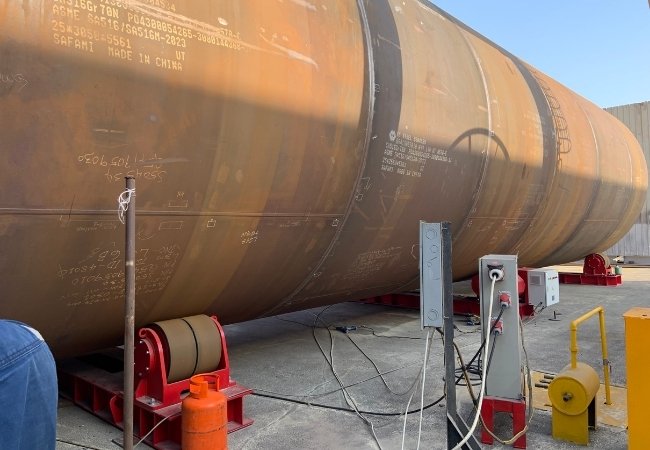
Pipeline Welding
While they are related in practice, pipe welding and pipeline welding differ somewhat in their usage and geographical area of operation. The following defines these differences:
1. Application and Scope
Pipe Welding: This is the welding of pipes that serve small-scale systems such as plumbing, HVAC systems, and industrial machinery. These are usually pipes serving a building or a facility at a localized level.
Pipeline Welding: This pipeline is done on much larger scales – for example, oil, gas, and water pipelines. The welding may involve long lengths of pipe laid across vast areas and usually out in the open
2. Environment
Pipe Welding: Most of the pipe welding is done within controlled conditions, like in workshops or even on-site at a construction area. Conditions here are easier to control.
Pipeline Welding: It is very much an outdoor job that the welder has to be performing under relatively harsh conditions of temperature, wind, or perhaps an extremely isolated location.
3. Materials and Pipe Sizes
Pipe Welding: Various pipe sizes and different types of materials such as steel, stainless steel, copper, and their alloys, depending upon the requirement of the system.
Pipeline Welding: Generally made from big diameter, heavy steel pipes to transport liquids and gasses in high volumes.
4. Techniques and Positions
Pipe Welding: Employs various techniques and welding positions, as the applications are made on a wide range of pipes with variation in size and material.
Pipeline Welding: SAW and SMAW, 5G and 6G are some of the specialized techniques and positions in pipeline welding since it operates under completely different demands due to its long and fixed position.
5. Objective
Pipe Welding: The good and quality joints aimed at smaller systems concerned with functionality and safety issues.
Pipeline Welding: The process gives assurance of structural integrity, leak-tight performance over long distances to guarantee efficient transportation of materials with safety.
Conclusion
Welding pipes involves some of the most critical processes in building systems that are strong and lasting for industrial purposes of carrying liquids, gases, and other products.
From choosing the right welding technique to mastering various positions and passes, each step requires precision and expertise to ensure weld integrity.
While difficult angles, environmental factors, and material compatibility bring their own set of challenges, professional welders overcome these by possessing the correct toolsets and training.
Understanding the methodologies involved, benefits, and steps to be followed are indeed what help pipe welding professionals contribute toward the construction of reliable infrastructure that stands the test of time.
Quality pipe welding is quite essential be it major pipelines or minor industrial systems. It forms the backbone for multiple vital operations all over the world.


 EN
 ES
 RU
 JA
 FR
 PT