

Have you ever noticed perfectly done welds on pipes or tubes? It is a result of orbital welding, an intelligent and fully automated method of joining metals. You can use it to achieve clean, uniform, and repeatable welds each time. It is beneficial for tasks demanding precision and cleanliness.
Nowadays, you can easily spot orbital welding across many industries like aerospace, medical, food, and semiconductor industries. It is very different from manual welding, where every action is controlled by an operator. In orbital welding, you don’t have to control the actions as they are managed by a machine.
The weld head goes around the pipe or tube, pivoting in a complete circle and maintaining the same speed, heat, and angle. The end result is strong, unified junctions. All because of the machine that allows you to eliminate variability and produce uniform and error-free joints. Let’s learn about orbital welding systems, machines, practical applications and much more.
What Is Orbital Welding?
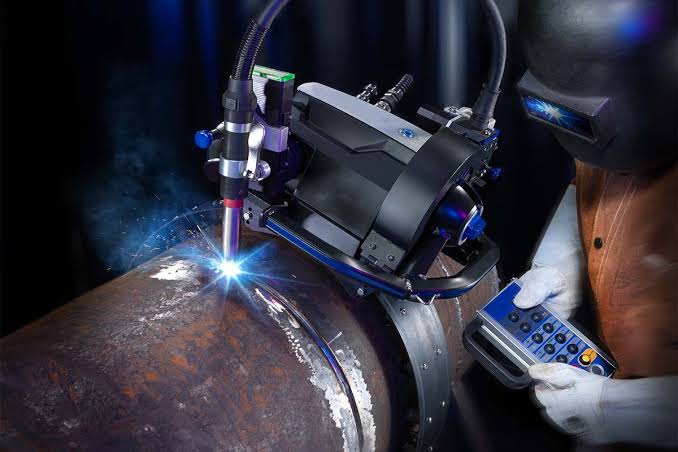
Orbital Welding
What do you understand by orbital welding? It is a type of automated welding in which your welding torch spins a full 360° circle around an immobile pipe or tube. The mechanism guarantees you uniform and accurate welds all the way around.
If your weld is uneven or flawed, it can pose dangerous risks. Hence, orbital welding was first developed in the 1960s for the aerospace industry. So, reliable and clean joints are no longer difficult for you to achieve. Today, you can see orbital welding being used for everything from medical devices to chemical plants.
When humans control the welding operations, variability is high. However, the orbital welding setup is machine-controlled, which ensures uniformity and predictability. This means you get repeated high-quality welding done in a row, all in the same setup. This helps you save a lot of time, along with lowering waste production.
Most of the time, orbital welds are performed using the Tungsten Inert Gas (TIG) method. It is quite common to refer to this as orbital TIG welding or GTAW orbital welding. You can use this method ideally for thin sheet metals and stainless steel tubing.
How Does Orbital Welding Work?
Once you understand the fundamentals, learning how to do orbital welding is straightforward. It involves the use of a weld head, power supply, control unit, and a cooling system. In this procedure, you need to hold the tube or pipe stationary while the weld head swivels around it and produces a uniform arc.
The power supply will automatically adjust the amperage and voltage, while the control unit oversees the welding sequence. Each project has specific requirements, so you can adjust parameters, including feed rate, temperature, and angle of rotation. Such automation guarantees you consistent weld quality by eliminating the possibility of human error.
There is a lot of repetitive work in industries. However, you can store different welding programs in your orbital welding machines. During orbital TIG welding, you must use a protective inert gas, usually argon, to shield the weld seam from oxygen and other contaminants.
You must prefer this for industrial work that requires welds to be flawless and to resist corrosion. When you are considering how to do orbital welding, think of it as an application of high precision engineering. A technique merged with clean and controlled automation.
Types of Orbital Welding
For orbital welding, there are many approaches you should be aware of. You must remember that different kinds of materials, thicknesses, and job applications require different approaches. However, all these types have their own benefits and drawbacks as well.
Orbital tube welding, orbital TIG welding, orbital MIG welding, and orbital plasma welding are the main types. Let’s dive deeper into each technique to help you choose between them.
Orbital Tube Welding

Orbital Tube Welding
You will come across clean and precision-oriented industries using orbital tube welding. The welding technique connects tubes or pipes as the welding head spins completely around them 360°. This technique helps you achieve even, smooth and utmost clean welds free from all sorts of contamination.
If your welding tasks are related to food, beverage, and pharma systems industries, you might want to select tube welding. In such industries, cleanliness is most fundamental, and even the slightest bit of impurity can lead to huge problems.
With this technique, you don’t have to worry about guesswork or uneven joints. Your system, fully controlled by a computer, will ensure every weld is similar. You can use tube welding for welding small hand-weldable tubes of stainless steel. The closed welding head will help you save the weld from air to prevent oxidation.
Furthermore, you can also spot orbital tube welding being utilized in sanitary pipelines, water treatment systems, and chemical plants. This type is the best option if you want clean, contamination-free joints that are aesthetically pleasing and durable.
Orbital TIG Welding
Orbital TIG welding, or GTAW orbital welding, is a technique where the orbital welding machine is equipped with a tungsten electrode. Your electrode must have an inert gas like argon. If you want to create welds that look smooth and are accurate, this method will work wonders for you.
You won’t have to deal with a lot of spatter and distortion. By automating this technique, you can control arc voltage as well as rotation speed. With orbital TIG welding, you can produce extremely excellent and uniform results even when working on small or thin-walled tubes.
However, you might have to spend a lot of time as compared to MIG, but the flawlessness and precision are unmatched. This is the reason why the orbital welding technique is chosen in the aerospace, medical and semiconductor industries. If you are working in industries such as semiconductor manufacturing, you must ensure contamination-free welded joints.
Orbital TIG gives you just that. Select this technique for small tubes with diameters of four inches or less. If your project requires welds of excellent appearance and repeatable quality, orbital TIG welding is another great choice.
Orbital MIG Welding
Another welding method is the Orbital MIG welding, which prioritizes speed and efficiency. For this method, you need a continuous wire feed. The difference is that you can add metal at a faster pace than with TIG welding. It is ideal if you use this method for welding thick material and long seam applications.
You can spot the technique being widely utilized in industries like shipbuilding, construction, and oil and gas, which take advantage of its speed. This welding technique creates a higher volume of spatter. So, if you want a sterile environment, Orbital MIG can be a poor choice. It is ideal when you need high productivity and can tolerate surplus spatter. MIG welding equipment is designed for high industrial volumes.
These high deposition rates allow you to do a lot of welding in less time. If you are working on large projects, let the power and low cost of MIG welding make the task easier for you. Its speed, power, and efficiency make it the right technology for you. Keep in mind that neatness will take a hit, but the benefits far outweigh that drawback.
Orbital Plasma Welding
With Orbital plasma welding, you can take TIG welding to a new level. It employs a rapidly focused plasma arc, allowing you to access a greater range. The technique allows you to weld thicker materials as thick as 8 mm in a single pass. You can achieve strong, reliable, and clean joints with every pass.
This process involves pushing an ionized gas through a small nozzle. This generates a narrow and intense arc. With the technique’s deep penetration, you can smooth out tough and difficult metals. Hence, if your project is related to aerospace, power generation or the chemical industries, you can use Orbital plasma welding.
You must keep in mind that plasma welding can be complex compared to other methods. Even though it guarantees clean, consistent and durable welds, the process requires an intricate setup, making it costly. Hence, you should go for it if you are dealing with high-stakes applications that demand precision and strength. So, you will be able to compensate for the cost with the quality of the weld.
The table below compares different orbital welding methods.
| Type | Advantages | Limitations |
| Orbital Tube Welding | Clean, uniform, contamination-free welds; ideal for sanitary industries | Limited to tubes and small parts; high setup cost |
| Orbital TIG Welding | Precise, spatter-free welds; perfect for thin materials and small diameters | Slower process; requires skilled setup |
| Orbital MIG Welding | Fast, efficient, high deposition rate; good for thick materials | More spatter; not suitable for clean environments |
| Orbital Plasma Welding | Deep penetration; strong, clean welds for thick materials | Complex setup; expensive and skill-dependent |
Orbital Welding Equipment and Machines

Orbital Welding Equipment and Machine
If you want consistent speed and accuracy, you need orbital welding machines set up in your production lines. When you are setting up a full orbital welding machine, you need a few things. These include a power source, a weld head, a controller, and a cooling system.
Your orbital welding equipment will take care of current control and the gas flow, as well as the speed of rotation. You can easily spot the weld head moving around the pipe or tube. It’s the most recognizable component. If you have smaller tubes, you need a closed-head system to keep the tubes sealed to prevent contamination.
However, if you are dealing with larger pipes, set up an open-head system as it is more flexible. Modern orbital welding machines allow you to program and save various welding parameters. Hence, you can easily carry out repeated, consistent, and high-quality welds.
Top Orbital Welding Companies
There are many orbital welding companies that are experts in developing high-quality systems. These deliver their services across the globe. No matter which industrial project you are working on, these companies have reliable systems that ensure accuracy and consistent performance.
Below you can find some of the well-recognized companies in the field of orbital welding.
| Company | Country | Key Focus | Main Products |
| Arc Machines, Inc. (AMI) | USA | Advanced orbital welding systems | Orbital TIG welders, power supplies, weld heads |
| Polysoude | France | Automated and orbital welding | TIG & MIG orbital systems, controllers |
| Orbitalum Tools GmbH | Germany | Tube cutting and orbital welding | Tube saws, closed weld heads, power sources |
| Magnatech LLC | USA | Portable orbital welding equipment | Tube and pipe welders, power units |
| Liburdi Automation Inc. | Canada | Automated plasma and TIG welding | Orbital plasma and TIG systems |
| Swagelok | USA | Clean piping and welding solutions | Orbital welding systems, fittings, training |
| Axxair Group | France | Tube processing and welding | Tube cutting, facing, and welding machines |
| Lincoln Electric | USA | Industrial and automated welding systems | Orbital weld heads, controllers, automation tools |
Industries and Applications
You can notice the growing trend of Orbital Welding being used by industries which demand quality, cleanliness, and precision. This is because orbital welding makes repeatable, flawless welds unlike any other welding form.
For instance, if you want to transport gas, liquid, and chemical, you must rely on a high safety and precision system. This is what orbital welding offers. Let’s examine why this orbital welding is valued and how it is utilized in various industries across the globe.
Aerospace Industry
Industries such as aerospace cannot afford to have any welding flaws. For this reason, you can spot orbital welding being used in fuel lines, hydraulic systems, engine and gas exhaust components. The aerospace industry demands welds to withstand high pressure and vibration. Hence, you need to make sure that your joints are strong and uniform.
Using orbital welding, you can weld lightweight materials like titanium and stainless steel without compromising on precision and control. Furthermore, the industry mostly has small and hard-to-reach parts. To make your job easier, the automated orbital systems weld safety-critical components with fine detail and consistency.
Medical Industry
In medicine, you need to take care of cleanliness and accuracy. With orbital welding, you can ensure sterility and corrosion resistance of surgical equipment, hospital-grade tubing and other frames and structures. If you are able to make your welds smooth and crevice-free, the bacteria won’t build up.
Hence, orbital welding will help you maintain essential infection control. You must remember that the level of weld purity you achieve directly impacts patient safety. Hence, you can benefit from orbital welding by using it for medical gas systems and implantable devices.
If you are a supplier of hospital and surgical equipment, you should be using orbital TIG welding for the medical steel and titanium parts. You won’t have to worry about hygiene. The weld joints are clean and polished, free of contamination or discolouration.
Food and Beverage Industry
If you’ve toured a contemporary food processing facility, you would notice that almost every shiny metal tube is welded using orbital welding. For this industry, cleanliness is not only a preference, it is an absolute requirement.
Orbital tube welding is a great technique for projects involving sanitary pipelines. These pipelines carry different liquids like dairy and soda. Hence, you need to make sure that their internal surface is the smoothest to prevent bacterial growth and product buildup.
Since the welding head is able to pivot uniformly, you can greatly reduce the likelihood of irregular welds. This will help you prevent food trapping, which can otherwise lead to contamination. Furthermore, you don’t need a filler material for this process, which makes it easier for you to clean and maintain the system.
This is why beverage manufacturers, when building and upgrading their production lines, opt for orbital welding systems. The orbital welds give you a smoother finish, reduced servicing downtime, and systems that last longer.
Pharmaceutical Industry
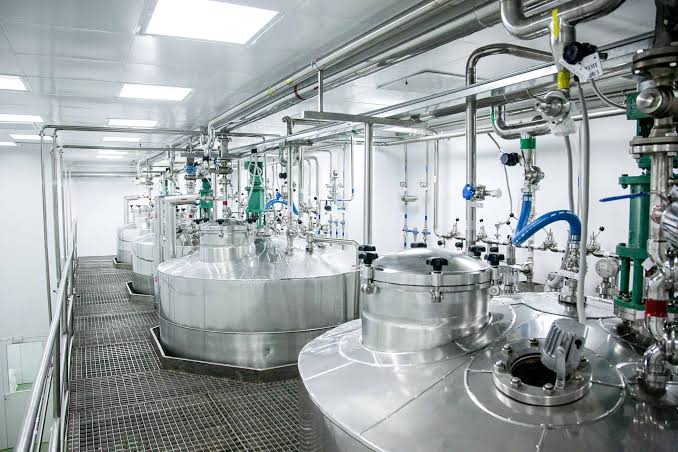
Orbital Welding in Pharmaceutical Industry
In the pharmaceutical sector, you need to ensure sterile welds as they help produce products. For tubes that transport purified water, gases, and chemical solutions to be used in clean rooms, orbital welding works wonders. It easily fuses stainless steel tubes free of cracks, pores, and discolouration, preventing any contamination.
With automated welding, you can accomplish this goal through the use of a closed system that is fully bathed in an inert gas shield. Orbital welding also allows you to document every aspect of a weld.
This provides pharmaceutical companies with unparalleled weld documentation, including logs of the heat, time, and rotation speed used. By being able to trace such information, you can stay compliant with the strict requirements of the FDA and ISO 9001.
Semiconductor Industry
The semiconductor sector uses orbital welding more than any other sector. For chip manufacturing, ultra-pure gas and chemical lines are required for purity. You must ensure that all impurities are avoided in the welding process.
If you leave defects in the welds, it will lead to contamination, which can spoil the entire batch of silicon wafers. This is the reason why you should choose GTAW orbital welding to put stainless steel and nickel alloy tubings together. These smooth, clean and uniform pipelines will be ideal for gas and chemical transportation.
Such uniformity helps you in constructing safe and dependable systems while maintaining the purity of microchips and electronic products. Just ensure that all welds have gone through a number of criterion checks, including a visual, microscopic examination, and a leak test. By doing so, you can guarantee perfection.
Other Applications
Aside from the main sectors, you can find orbital welding being used in the generation of power and the processing of chemicals. It is also beneficial for the oil, gas, and nuclear industries. If your industrial system requires airtight joints that can withstand high pressure, orbital welding can be of great advantage.
For instance, in power plants, if you use orbital plasma welding, you can efficiently join high-temperature piping with turbine parts. Similarly, in chemical industries, you can use orbital welding to create corrosion-resistant joints that can endure extreme conditions for years.
Advantages and Limitations
As with any technology, orbital welding has both benefits and drawbacks. However, the advantages it offers you outweigh the downsides, specifically when precision and sanitation are of the utmost importance.
Advantages of Orbital Welding

Orbital Welding Producing Precise Welds
Orbital welding is widely used because it has many advantages. Here, we delve deeply into what makes orbital welding so useful.
1. Consistent, High-Quality Welds
With the orbital welding system, you get the ability to receive the same high-quality product in each order. Once you have set the program, the system repeats the same steps in a sequence with each cycle.
So, you get identical welds that are smooth, precise and strong while functioning similarly. You won’t be able to attain this level of consistency, especially for long and complex projects, with manual welding.
2. Reduces Human Error and Fatigue
With automated systems of orbital welding, you can reduce human fatigue for tasks that are repetitive or detailed. It is even more beneficial for minimizing fatigue-related errors that result from shaking hands or poor angles.
All you need to do is set the parameters and let the machine handle the rest. The system will perform the welding without additional human input, offering you peace of mind.
3. Ideal for Clean, Sanitary Applications
You will find orbital welding being used across several industries, like food and beverage, pharmaceuticals, and even semiconductor manufacturing. The only reason is that the process is useful when hygiene is key. With orbital welding, you create smooth welds without cracks, crevices, or pores. Hence, you prevent the buildup of germs or other contaminants.
You also carry out the process under gas shielding to prevent oxidation and discolouration. All these features make orbital welding a trustworthy, clean, and sterile environment around the globe.
4. Saves Time on Large or Repetitive Projects
After you have done the initial programming, orbital welding machines can execute the same weld multiple times with minimal setup time. Hence, it is beneficial if your project involves bulk production.
Such large-scale projects include installing stainless steel tubing systems and aerospace parts. Just save your custom welding settings that facilitate tasks involving different sizes and materials. The time you will be saving on these repetitive tasks is massive.
5. Reaches Difficult or Confined Spaces
In some industries, particularly aerospace, there are certain welded joints which are very difficult for you to access with manual welding. So, if you are working on small, closed, and intricate parts, orbital welding will be of great help. The design and small size of orbital welding heads make it possible to manoeuvre in and around confined spaces and work at difficult angles.
6. Perfect for Thin-Walled Materials
If you are working with thin materials, control of heat and stability of the arc is critical. Here, orbital welding can perform outstandingly. For thin stainless steel or titanium tubes, you must opt for orbital TIG welding. This will help you weld joints perfectly without burning through or distorting the material.
7. Cleaner Welds and Less Post-Work
Due to automation and inert gas shielding, you can produce welds that are smooth and clean. You won’t have to deal with a lot of spatter. So, no need to worry about grinding or polishing. With orbital welding, you won’t just save time and labour. The welds will easily pass inspection upon the first assessment.
Limitations of Orbital Welding
Orbital welding doesn’t have many disadvantages. However, there isn’t any system that is completely free from drawbacks. Before adopting the orbital welding system, you must know what some of its limitations are.
1. High Initial Cost
The first issue is the price. You need a considerable initial capital investment for orbital welding machines and the other necessary equipment for the setup. If you have a small workshop or a project that doesn’t demand high-volume output, orbital welding will be expensive for you.
However, if your business requires high-volume, consistent production, orbital welding will be cost-effective. It will help you save on labour expenditure and rework costs, making the investment worthwhile.
2. Requires Skilled Programming and Maintenance
The system may work automatically, but you still need a qualified person to set it up. Your operator should be well aware of the setup and its variables, like current, voltage, gas flow, and the rotation speed. Furthermore, you need to maintain the system regularly to retain optimal performance.
3. Not Ideal for Very Large or Odd-Shaped Parts

Orbital Welding on Thin Pipe
Orbital welding works best on rounded or tube-shaped items. So, if your components are larger or oddly shaped, orbital welding won’t be as effective. You can’t place them within the welding head. These are best suited for manual welding.
4. Slower for Small, One-Time Jobs
For simple, one-time small repairs, manual TIG or MIG welding is much quicker. However, if you are carrying out repetitive tasks and batch work, orbital systems are much better. They require you to have an extensive setup and programming, making them effective.
5. Repairs and Adjustments Can Be Tricky
If something goes wrong in the middle of the welding process or a setup needs to be changed, orbital systems take time. You need to stop and reprogram the system. However, manual welding is more flexible. Unlike automation that needs to be accurately recalibrated, manual readjustments are quick and easy to make.
| Advantages | Limitations |
| Produces consistent, high-quality welds with repeatable results | Requires high initial investment for setup and equipment |
| Minimizes human error and fatigue through automation | Needs skilled operators for programming and maintenance |
| Ensures clean, sanitary welds for hygienic industries | Not suitable for very large or irregularly shaped parts |
| Saves time on repetitive or large-scale projects | Slower for small or one-time welding jobs |
| Accesses hard-to-reach or confined spaces easily | Adjustments and repairs can be time-consuming |
| Performs excellently on thin-walled materials | Limited flexibility compared to manual welding |
| Creates smooth, clean welds with little post-processing | Regular maintenance is required for optimal performance |
Conclusion
The industrial world, dependent on highly accurate joints, has transformed with orbital welding. The process allows you to achieve clean, robust, and repeatable results. Hence, you can see it being utilized across various industries, including food processing and aerospace.
Hence, how to orbital weld is not just a new skill, it is a necessity. You need to start with the basic training and select the right orbital welding machine. With this advanced technique, you can ensure quality control and consistency in your results. When you are equipped with the right orbital welding equipment, you can simplify the most complex projects.
As the technology keeps advancing, you will see GTAW orbital welding systems become more efficient. Adopt orbital welding to revolutionize your manufacturing systems, one weld at a time.
More Resources:
Orbital Welding – Source: Wikipedia
MIG Welding Vs TIG Welding – Source: SENLISWELD
Types of Welding Process – Source: SENLISWELD


 EN
 ES
 RU
 JA
 FR
 PT