

Though welding tables aren’t the most exciting tool in your workshop, they impact almost every project. If your welding table flexes, moves, or makes holding workpieces difficult, you will most likely waste a ton of time fixing mistakes.
A good quality welding table setup will help you work faster and cleaner with minimal issues. If you make gates, frames, repair machines, or carry out custom metalwork, your welding table will be the most used tool in your workshop.
Once you start working on a well-designed welding fixture table, the difference in accuracy, comfort, and workflow is beyond comparison.
Selecting the right welding table is not about popularity but about what meets your welding requirements. Let us make it easy for you to choose the right welding table for your workshop.
Why Choosing the Right Welding Table Matters
Before we take you through the features of a good welding table, it is important to understand why you should choose the right welding table. A welding table is not just a flat surface; it is a major component in optimizing accuracy, speed, and the flow in your system.
Without an appropriate table, you will face multiple issues in each project you do. This can slow down your work progress, which can easily dissatisfy you. When looking at industrial welding tables, you are making the decision of how enjoyable or frustrating your daily work will be.
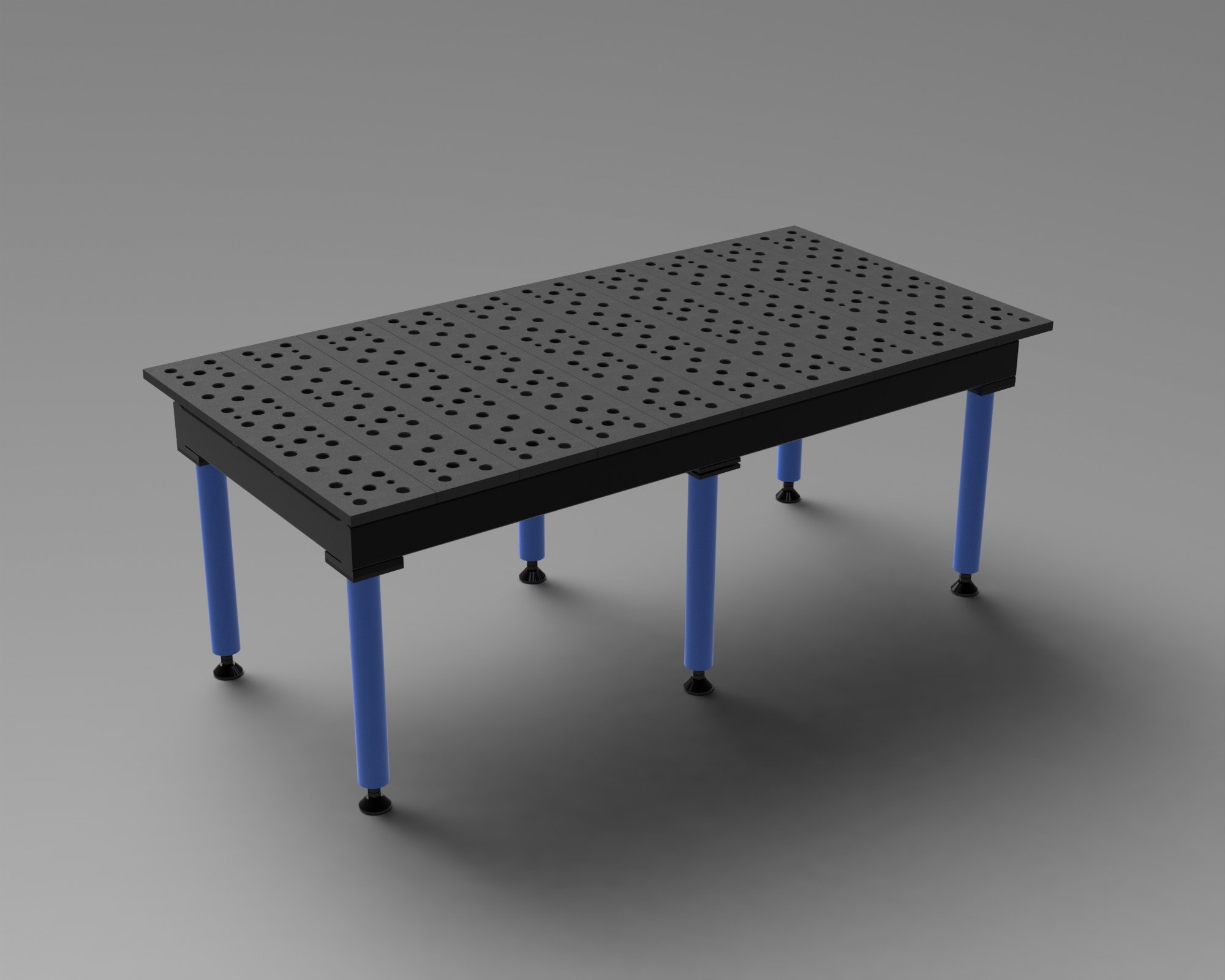
1- Helps Achieve Better Accuracy
Your welding table significantly affects the final aesthetics and functionality of your project. Without a straight, square, and consistent table, you will have an unstable or uneven welding surface. It will cause your materials to shift during the welding process. Now, you wouldn’t want all your measurements to be thrown off like that.
When this happens, more adjustments and grinding are required, which further wastes time. This stability is even more crucial when you are working with larger assemblies. With a stable welding fixture table, you get:
- ✔Cleaner fit-up
- ✔Easier alignment
- ✔More accurate welds
- ✔Better repeatability
The workflow becomes smoother.
We all know that clamps slipping or material shifting mid-process is one of the most frustrating things that can happen during setup. A welding table with clamps and fixture holes help you position your material properly with minimal effort. So, instead of wasting time on changing your setups, you just lock your parts in place and start your work quickly. This helps you save time on almost every single project you have to complete.
2- Expands your Skill
A common mistake many welders end up making is buying the cheapest table. They often outgrow it quickly and have to get a new one a short time later. Hence, a right table is the one that can adapt to intricate projects. This allows you to grow your skills without worrying about upgrading your table. The good welding table suitable for more advanced projects includes:
- ★Better fixturing
- ★Stronger clamping
- ★More tabletop space
- ★Improved heat resistance
3- Improves the Weld Quality
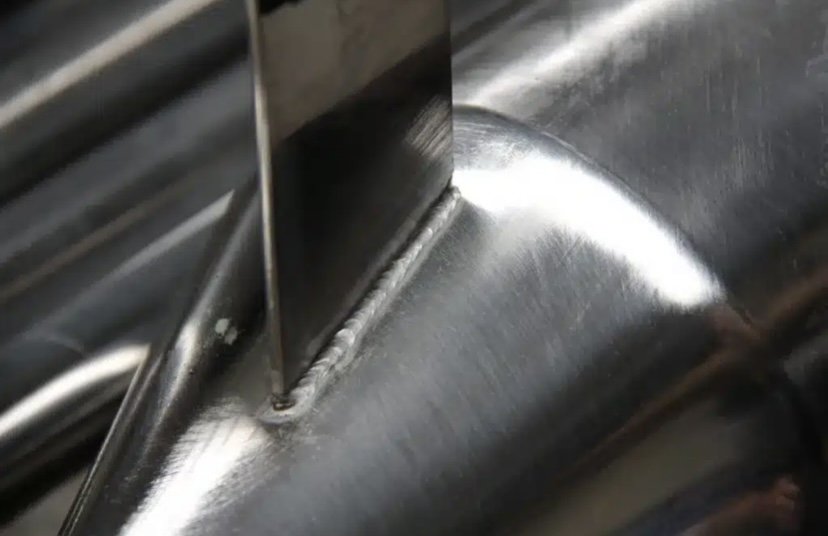
Many people fail to acknowledge clamping as a key component in the production of high-quality welded assemblies. If your materials end up moving even slightly while the welding process is going on. You lose your desired alignment. When the project cools down, your welded components are in a complete disaster.
A high-quality welding table provides you with multiple secure clamping points. These assist you in holding your material in the correct position throughout the cutting and welding process. The stability helps you attain high-quality joints that are clean and tight. So, there is minimal to absolutely no need for reworking later on. There is no doubt that a solid set-up not only improves weld quality but also makes the welding process much more enjoyable.
4- Handles Heat More Effectively
There is no fabrication possible without adding heat. However, you must know that not every welding table is made to withstand high temperatures. If your welding table is made poorly, it has a high chance of warping over time. You are likely to encounter this issue if you weld thick materials or large assemblies regularly. Once these thin or poorly built tables get warped, they lose their flat surface.
To overcome this problem, you should use a heavy duty welding table that is made to resist warping that occurs from heat. It will keep its stability, even with frequent use. This means that it will take a longer time to lose its flatness. Hence, long-term durability is a factor that you must always consider.
5- Makes your Workshop Safer
It is very easy to overlook safety when you are buying a welding table. However, you should know that if your table is unstable, it can do one of the following:
- ⚠️Tip over when subjected to heavy weights
- ⚠️Cause workpieces to shift
- ⚠️Make you work in difficult positions and cause injury
If you get a solid industrial welding table, you can ensure a safe and controlled environment, which will help you improve the workflow of your shop. The right table gives you the opportunity to position and clamp the workpieces correctly and securely. This allows you to move about your project in a safe and confident manner. This not only guarantees your workplace safety but also keeps you protected.
Main Types of Welding Tables

Welding tables have great variations, and that is good news for you. Having variety allows you to meet the different demands of different set-ups. By selecting the most appropriate table for your welding task, you can complete it efficiently and cleanly despite its uniqueness.
Whether you are carrying out small welding tasks or large-scale industrial fabrication, there is a welding table to suit your work. Let’s explore the main types of welding tables to help you meet your work requirements.
1- Traditional Flat Plate Welding Tables
Flat plate tables are the most common type. You often see them a lot in small workshops. They have a thick, flat steel plate surface which is designed to withstand high temperatures and heavy weights. They are quite simple, but that’s the beauty of them. These tables offer you a reliable work surface for general welding tasks. If you’re a beginner or you need to complete a simple fabrication job, this style of table is a great choice.
2- Modular Welding Tables
When your welding tasks become professional, you need to move on from the simple flat plate welding table. A D28 modular welding table or 3D welding table incorporates precision grid holes that allow you to determine the exact position of clamps and fixtures. You don’t have to do the guesswork or random spacing anymore. With this table, you have the ability to build even more controlled and repeatable layouts. This helps you increase your chances of attaining accuracy when creating identical parts or complex assemblies.
3- Heavy-Duty Welding Tables
Some jobs are just bigger and heavier. For those jobs, you need tables that can take on the load well. Heavy-duty welding tables have thick steel plates designed to withstand heavy weights while simultaneously protecting the table from warping. You can easily spot these sorts of tables in industrial units where large metal structures are being built. This is the type of table you need for tasks that involve heavy weights, force, or a lot of impact.
4- Adjustable Height Welding Tables
People say comfort is not that important in welding, but they are wrong. If you use adjustable tables, you can easily modify the height of your work surface. By doing so, you can avoid bending and stretching all day. At first, it may seem like a pointless feature. However, you will see its benefits quickly. The less strain you feel, the more control you can have over the welding work. This improved control is essential for the purpose of achieving clearer welds over longer periods.
5- Portable and Folding Welding Tables
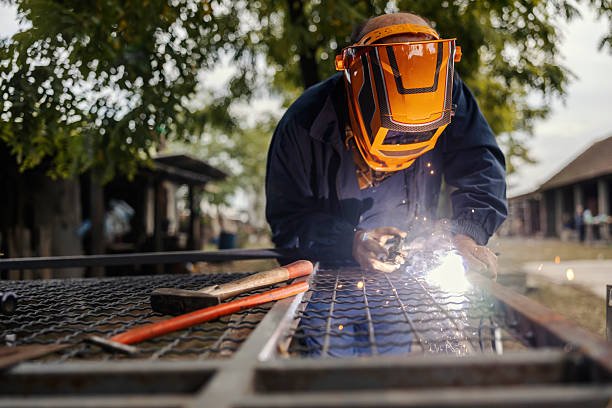
Welding work doesn’t always take place in the same location. Sometimes you need to weld outdoors as well. Hence, for mobile work, portable and folding welding tables are important. As they are built for movement, they are lightweight compared to the industrial ones. Hence, you can easily fold and carry them to fieldwork, small workshops, or wherever they are needed. The stability they offer is sufficient to carry out light to medium tasks.
6- Slotted or T-Slot Welding Tables
At times, your welding task demands flexibility without a full modular grid. For a middle ground between modular grids and standard workbenches, look to slotted or T-slot tables. These have long grooves that allow you to easily hold irregular, large, or heavy workpieces in position. The best part is that with slotted tables, you get the perfect balance of adaptability and strength. This is more beneficial for custom fabricating, where set-ups are rarely repeated.
7- Cast Iron Welding Tables
When utmost stability and precise measurement are necessary, nothing beats a cast-iron table. Cast iron can absorb vibrations better than anything else. Hence, it is an excellent choice if you are carrying out fine or detailed welding tasks. When accuracy and reliability are the most important concerns, cast iron tables are your best option. Just remember that the ease of transport shouldn’t matter to you.
8- Rotary or Positioning Welding Tables
There are scenarios where you have to weld around a particular object without being able to move around it. For such welding tasks, you must opt for a rotary welding table as it allows you to turn or position the workpiece easily. This is ideal for pipes, circular welds, and multiple angled work. It also helps you maintain a consistently good quality while saving lots of precious time.
| Welding Table Type | Main Benefit | Best Use |
|---|---|---|
| Flat Plate Tables | Simple and strong | Basic welding jobs |
| Modular Tables | Precise clamping and setup | Professional and repeat work |
| Heavy-Duty Tables | Handles heavy loads | Industrial fabrication |
| Adjustable Height Tables | More comfort and control | Long working hours |
| Portable & Folding Tables | Easy to move and store | Outdoor and mobile work |
| Slotted / T-Slot Tables | Flexible positioning | Custom fabrication |
| Cast Iron Tables | High stability and accuracy | Precision welding |
| Rotary Tables | Rotates workpieces easily | Pipe and circular welding |
Cast Iron vs Steel Welding Tables
When you come across cast iron and steel welding tables, you might assume that both of them do the same thing. However, each has its own pros and cons. Once you start working, you feel the difference very quickly. When choosing between the two types, you must consider the work you do and how your shop is used on a daily basis. Let’s make it easy for you to understand the difference between cast iron and steel welding table.
● Flatness and Surface Accuracy
Cast iron welding tables have superior surface flatness as they are naturally flat. These are machined to ensure surface accuracy for longer periods of time. Hence, they offer the best precision possible. Steel tables can be flat, but they rely on the quality and thickness of the design for long-term accuracy. If your work requires close alignment, this is where you will begin to see the difference.
● Strength and Heavy-Duty Use
If you are carrying out rough and heavy fabrication, steel tables are the choice without a doubt. You can drop parts, clamp aggressively, and work on large assemblies with absolutely no worry. On the other hand, you have cast iron, which is strong, but it doesn’t like constant impact and abuse. It is more suitable for a controlled environment.
● Heat Behaviour
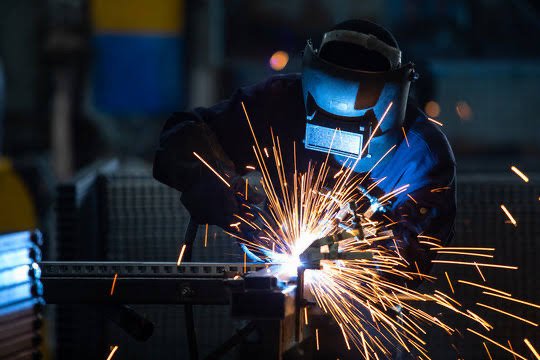
During long welding sessions, cast iron manages heat in a slow, steady way to minimize distortion of the table. Hence, if your work involves precision, this is a great plus point of cast iron. Steel prefers the opposite. It gets heated up and cooled down quickly. This behaviour can be preferred by welders when they are working faster and often switching tasks. Hence, if you have to manage continuous welding runs, you can pick a steel table.
● Durability
Cast iron maintains its shape over time, but heavy, sudden impact can break it. Fixing broken cast iron is not easy. This is why you will find steel tables to be more practical. Since steel is easier to resurface, grind, and repair, tables made from steel are a much safer long-term investment. So, if your table undergoes a lot of wear and tear, select steel tables for your welding work.
● Weight and Stability
When you compare the weight of cast iron to that of steel, cast iron feels way too heavy. However, you must not fear its weight as it works in favour to help provide stability to the table. It saves you from worrying about it moving anywhere. On the other hand, steel tables can feel heavy, but they can be designed in a way that allows them to be lighter than cast iron. However, if you want a table that doesn’t move at all once you have placed it, cast iron is the way to go.
● Flexibility and Customisation
Steel tables are definitely more practical. You are able to customize them easily by adding things to them, such as fixtures. This is not really possible with a table made from cast iron, as they are much more rigid. If you don’t want to purchase a new table for every new project, steel tables are the best option. With steel stables, you have the freedom to customise according to your project’s requirements.
● Value for Money
It’s a fact that cast-iron tables can be considered a luxury option. The way they are manufactured and processed makes them more expensive. However, the value really shines in the stability and precision it offers you. Steel tables are the opposite. They are available in a broader range of prices and options. This makes these tables more accessible to you, whether you are working in a home garage or in a full-scale workshop. So, if you want a budget friendly option, you can select steel tables otherwise cast iron will get your job done.
● Maintenance and Long-Term Care
Cast iron tables do need more love and care to ensure a good surface quality, as they can rust easily. However, maintenance isn’t that difficult; you just need to add a simple coating, which works great for a long period of time. On the other hand, steel tables are preferred in fast-paced environments as they rarely require maintenance. So, in the day-to-day of a workshop, steel tables are a better choice as they can get dirty without causing too much trouble for you.
| Feature | Cast Iron Welding Tables | Steel Welding Tables |
|---|---|---|
| Surface Accuracy | Highly flat and precise | Depends on build quality |
| Strength | Strong but less impact-resistant | Best for heavy-duty work |
| Heat Handling | Reduces distortion, steady heat control | Heats and cools quickly |
| Durability | Keeps shape well but can crack | Easier to repair and resurface |
| Weight & Stability | Very heavy and stable | Lighter and easier to move |
| Customisation | Limited flexibility | Easy to modify and add fixtures |
| Cost | More expensive | More budget-friendly |
| Maintenance | Needs protection from rust | Low maintenance |
| Best For | Precision and detailed welding | Daily workshop and industrial use |
How to Choose the Right Welding Table
Selecting the right welding table is never about the most expensive or the strongest-looking table. Focusing on how tables actually perform when you are welding day in and day out in the shop is actually how you pick a welding table. You need a table that will keep your work aligned, stable, and easy to manage.
Once you’ve found a table that fits your budget, you need to go beyond the surface and focus on what really matters when it comes to welding.
1- Table Top Thickness
The table top thickness is the most important thing to consider if you want your table to stay flat for a long time. If you pick a thin table, it will easily warp and bend over time. This is more likely to happen if you are carrying out heavy welding jobs or assemblies where heat easily builds up.
For serious work, you should aim for 3/8” steel. If your shop is doing heavy fabrication, you should go with 1/2” steel to hold up over time. You don’t want to second-guess the surface of your table every time you put a part down.
2- Surface Flatness
A welding table is essentially a reference point. If it is not flat, everything you build from that point will have that error. At first, it might not seem noticeable, but it becomes noticeable when parts do not align. If you have a properly machined surface, you can evenly align your assemblies. When everything fits smoothly without any force, it helps avoid frustration during set-ups.
3- Material Choice
There are many reasons why most people often choose steel over cast-iron welding tables. The steel tables offer toughness along with ease of maintenance. It’s ideal if you wish to go several years without worrying about the upkeep. If the surface develops defects, you can easily get the table fixed without a lot of effort.
On the other hand, cast iron will suffer in an unorganized welding workshop. It does offer the amazing stability and precision welders always desire, but it is far more brittle. This makes it unsuitable for rough environments. So, if you are carrying out regular welding work in heavy-duty set-ups, steel definitely will be a better choice.
4- Table Size
Size is an important component of work table design, but is often overlooked. Work tables that are too small lead to constant repositioning of workpieces, which is inefficient. Tables that are too large can be awkward and take up unnecessary room in a shop.
Hence, you should select a work table that is appropriately sized for the scale of work that you typically do. A four-by-eight-foot work table is a popular option in many workshops as it allows adequate space for most fabrication projects.
5- Weight Capacity & Structural Rigidity
Welding tables are all about strength. They not only support a lot of weight, but they are also subjected to the forces and vibrations that come with the processes of welding, striking, and hammering.
By selecting a strong, well-braced frame, you ensure that everything stays put while you are welding. If your weld table just flexes slightly, it can cause many alignment issues. It is important for your weld table to feel solid every time you lean on it.
6- Hole Pattern & Clamping Compatibility
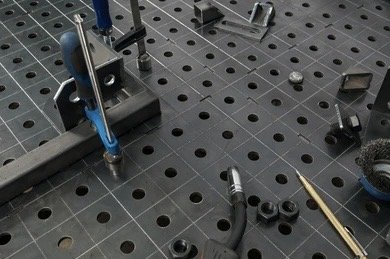
During the welding process, every welder has struggled to hold parts in place. This is the problem that the right welding table can easily solve. With a suitable grid hole system, the table gives you control over clamping each part in an appropriate location.
It acts as an alignment guide for your setups, helping you avoid guesswork. Most systems offer metric grids of 16mm or imperial spacing of 5/8”. With the help of clamps and stops, you will notice how swift your workflow becomes.
7- Heat Resistance & Spatter Handling
Welding tables have to deal with heat, sparks, and constant grinding. They should be able to handle these stresses without getting wrapped up or losing their evenness over time. Hence, a right welding table should be heat-resistant with good spatter handling properties.
Such tables help you avoid worrying about your welding table getting damaged and losing its surface integrity. This enables you to divert all your focus to your welds. Every busy workshop demands such a reliable surface.
8- Height, Portability & Budget
When selecting a welding table, it is vital to consider how you carry out your day-to-day work. The height of the table (typically 30-36 inches) can make a huge difference, especially if you are working for long periods of time. If your tasks are switched throughout the day, a height-adjustable welding table can be more beneficial.
Lastly, pay attention to your workflow. If you carry out work in one place, it is better to choose a heavy welding table that stays put. However, if your work involves moving frequently, get a portable welding desk. When working on the budget of your welding table, try avoiding the cheapest one. You’ll feel the effects of your mistake later on.
Industrial Welding Table Features Worth Looking For
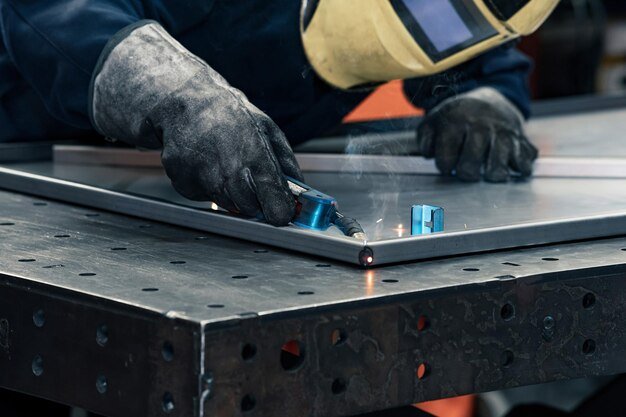
Industrial welding tables aren’t something you can pick without doing proper research because they are the starting point in your fabrication process. An ill-constructed table will result in ill-constructed projects. Hence, you need a solid, flat, and well-constructed table for your work.
When selecting a table for a serious shop environment, your focus should be on strength, accuracy, and repeatability. These determine the tables’ ability to maintain production efficiency. You’ve got to think about which features genuinely affect your workflow, not solely how it appears on paper.
● Heavy Table Top Thickness
Industrial welding stabilizes focus on thickness as it prevents the movement of the table when subjected to heat and pressure. Although a thin top may seem fine, it is not suitable for industrial work. The table will only keep its shape for a short time before you can start noticing bulges from repeated welding. When you select an industrial table with a thick steel top, you gain the advantage of long-term stability. This is important because you don’t want to worry about bulging and distortion in industrial settings. It, in turn, helps create a more controlled and predictable workspace.
● High Surface Flatness & Precision Machining
Flatness is one of those features you don’t appreciate until you use a workbench that doesn’t have it. Even tiny amounts of unevenness can result in alignment issues when assembling frames or slightly more complex mechanical components. A machined surface gives you a reliable reference point, so when you put something down, you can be confident it’s put down correctly. You’ll appreciate that your industrial setups are becoming quicker, and your results are becoming more consistent without putting in additional effort.
● Rigid Frame Construction
The top plate gets all the attention, but the real strength comes from underneath. Without lateral or diagonal bracing, control, and structural stiffness, the table will flex when you apply pressure, even if the top is thick. You want strong legs, gussets, and cross bracing to hold everything together in industrial setups. Such environments demand the table to stay in place even when subjected to heavy weights.
● Modular Hole Grid System
This is where the magic begins. Now, with a hole grid, you can clamp, align, and repeat the same setup. Industrial workflows make it difficult for you to draft and measure the same things over and over again. This helps you overcome the problem and save lots of time, making your workflow efficient. When you integrate stops, fixtures, and clamps to your grid, your industrial fabrication becomes easy and swift. Industrial welding tables have this feature because this is the type of upgrade that takes you to the next level of productivity.
● High Load Capacity with Stable Support
Industrial work often involves heavy assemblies. Hence, the welding tables are designed according to the weights they have to bear. However, the table isn’t just made to handle the heavy weights but also to maintain stability under uneven loads. No one wants their table to shift or dip at the slightest pressure, interrupting their industrial workflow. Always remember that a stable table means stable welds.
● Heat, Spatter & Grinding Resistance
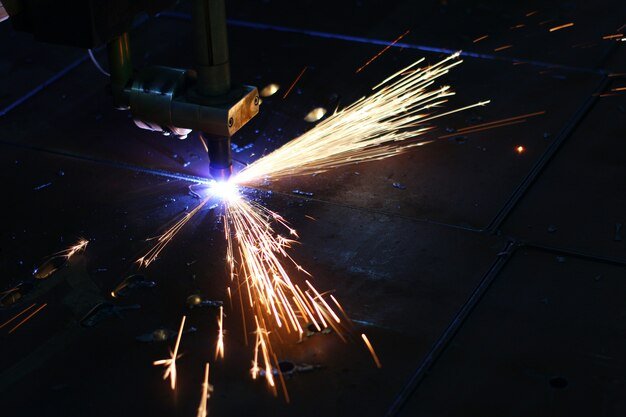
The industrial table goes through a lot of abuse in real situations. Expect sparks flying, grinding dust, and constantly changing temperatures. Good industrial tables can deal with all this without losing their shape or getting rough over time. When you don’t have to think about surface damage, you can totally concentrate on your welding.
● Standard Working Height
Don’t let industrial set-ups make you think that your comfort isn’t important. Nowadays, industrial welding tables have specific heights to suit your posture and control. This has a great impact on your overall welding performance. The best range for a height is typically 30–36 inches. However, for industrial set-ups, adjustable height is more convenient as multiple people or tasks are involved.
● Strong Grounding Performance
Industrial environments demand a welding table with electrical grounding, as it has a direct effect on arc stability. This is achieved by a clean, solid surface maintaining consistent contact. If the table has inconsistent or poor grounding surfaces, it can cause the arcs to be unstable. This makes the entire welding operation unpredictable.
● Clamp & Fixture Compatibility System
An industrial workbench can become far more useful when paired with a complete set-up of clamps and fixtures. Without that, a strong workbench feels limited. When all components are compatible and easy to install, setup takes less time, and consistency increases. In such an industrial welding set-up, you spend less time on fixturing and more time on actual welding.
● Durable Surface Treatment
Another important feature you must not miss in industrial welding tables is the surface treatment. It may seem like a minor detail, but it can greatly impact the life of the welding table used daily. Nitriding and anti-spatter finishes increase the durability of the table by reducing wear and making it easier for you to keep the table clean. A table with a good surface treatment will still look good and help with production even after years of use in the harsh industrial environment.
Conclusion
When buying a welding table, don’t get too attracted by those that are big, bulky, and expensive. It is better to choose the one that fits your type of work. A table that is flat, stable, and designed to be user-friendly is going to help improve the speed and accuracy of every weld. Every fabrication will be less mentally draining and frustrating.
The options are endless, but the goal is the same. Whether it be a steel table, a modular table, or a heavy-duty table, a good welding table is going to give you better control. This means better results every time you weld. So, before selecting your welding table, plan out your workspace, the fabrication you are going to do, and the projects you have to work on.
All these will influence your choice of the best welding table. However, remember that the right table is the difference between a smooth welding process and an inconvenient, frustrating, and slow process. The goal is to make each fabrication step, including welding, clamping, and setup, a good experience.
Frequently Asked Questions
Q: What is the best material for a welding table?
A: The best material you can choose for your welding table is steel, as it’s durable, affordable, and easy to repair. It is also flexible enough to be used in multiple shops, in both fabrication and repair.
Q: Are modular welding tables worth spending money on?
A: Definitely. Modular welding tables provide you with better clamping flexibility as well as setup speed and accuracy. This is especially true if you find yourself fabricating frames, tubing, or even parts that require repeat production.
Q: How thick should a welding table top be?
A: It is advised to get 3/8-inch-thick table tops for welding workshops. They provide high strength and rigidity as well as good heat resistance and durability, all while weighing a manageable amount.
Q: How big or small should a welding table be?
A: Size should really be based on your routine projects and how much room you have available in the shop. Bigger isn’t better if it reduces your mobility or makes your workspace cramped.
Q: Do welding tables need fixture holes?
A: They don’t always have to be there. However, fixture holes allow clamping to be done quickly, easily, and more accurately during fabrication and assembly work.
Recommend Reading
Welding Table – WIKIPEDIA
Welding Table Accessories – SENLISWELD
2D Welding Table – SENLISWELD
Welding Table Clamp – SENLISWELD


 EN
 ES
 RU
 JA
 FR
 PT