

When you work with large, heavy parts, holding your workpiece in the correct position can become a burden. It can result in a lot of wasted time because you have to lift, turn, and reposition the big and heavy parts before you can start welding.
This problem can be solved with a heavy-duty welding positioner. Instead of positioning a heavy part yourself, which can be both mentally and physically draining, a heavy-duty welding positioner can rotate, tilt, and lift parts for you.
The welding positioner brings the weld joint to your convenient working position. This improves access and prevents strain, thus welding becomes consistent.
Let’s go through the advantages of welding positioners along with their applications. Learn how to make a wise purchase.
What Is a Heavy Duty Welding Positioner?
A heavy-duty welding positioner is an industrial framing machine used for holding and moving large workpieces while welding. They are designed to contain mechanisms that help rotate, tilt, lift, and carry out other combinations of movements to position the workpiece for welding.
The primary concept of these welding positioners is to eliminate the need for you to move yourself around the workpiece. You can achieve the desired welding position via movement of the workpiece by the machine.
How Does A Heavy Duty Welding Positioner Work?
Generally, the workpiece is mounted to a rotating component in the welding positioner. This may be a rotating table, a faceplate, a chucking system, or even a custom fixture. Then one or more controlled and sequential movements are processed by the welding positioner to move the workpiece.
For example, the simplest rotary positioner revolves around a workpiece along an axis. A 2-axis welding positioner can rotate and tilt the workpiece, while a three-axis welding positioner may be able to rotate, tilt, and lift the workpiece. This eliminates the need for the worker to manually move the entire workpiece repeatedly to access different welding positions.
A large number of industrial positioners also have adjustable speed rotation. This is important for welding circular joints, where slow and steady movements are preferred. The movement of the welding positioner is typically controlled by a pendant, remote control, foot control, PLC, or an automated welding system.
Why Are the Most Important Features?
There are many different designs, but heavy-duty welding positioners generally have these features.
When dealing with heavy applications, every component must be chosen based on the actual load and operating conditions.
| Feature | Function | Key Specification |
|---|---|---|
| Worktable | Secures the workpiece or fixture. | Table size, load capacity, T-slots, mounting holes |
| Drive System | Provides controlled rotation. | Motor power, gearbox, rotation torque |
| Tilt Mechanism | Adjusts the workpiece angle. | Tilt range, tilt torque, drive type |
| Frame | Supports and distributes the load. | Structural strength, stability, floor loading |
| Control System | Controls rotation, tilting, and movement. | Speed control, pendant/remote, PLC compatibility |
| Welding Current & Grounding | Provides electrical continuity during welding. | Rated welding current, grounding capacity, electrical compatibility |
Why Should Positioning Matter In Welding?
The position in which you are welding impacts your access to the joint, comfort level, consistency of the weld, and how productive you can be. Sometimes joints are difficult to reach. Hence, you have to weld in positions that require you to stretch, bend, kneel, and in some cases, work in awkward positions as well. A positioner, on the other hand, allows you to change the placement of the workpiece.
The machine can rotate the component to a position that allows you to weld more comfortably. Hence, you don’t have to do the excessive manual handling. Positioner machines can rotate workpieces through large angles. This allows some of the previously inaccessible areas to be accessed.
Why Use a Heavy Duty Welding Positioner?
Repeatedly moving fabrication elements that weigh several tons is time-consuming, costly, and risky. For the task, you need additional equipment and more labor to support the unnecessary physical demands.
However, heavy-duty welding positioners move workpieces to the optimal welding position via controlled movement. Below are some of the common benefits you can get from a heavy-duty welding positioner.
● Improve Welding Access
You can make your welding work easier if you have better access to joints. It simplifies the welding process by eliminating the need to move around and look for the best work position. You can view the workpiece in the best possible orientation. This helps you focus on your welding technique.
This becomes very important when you have to weld on opposing sides, or at different angles to other welds. You can simply tilt the workpiece or rotate it, as opposed to walking around the workpiece to get to the different joints. If your workpiece is circular, such as a tank, pipe, pressure vessel, or flange, you can continue to rotate the workpiece to maintain a constant optimal working position.
● Reduce Operator Fatigue
Welding heavy components that are large and irregular can become even more exhausting. You have to bend, stretch, reach, or climb in order to find a suitable working position. This can be physically demanding, leaving you with too much fatigue. A welding positioner can help minimize these movements by allowing you to reposition the orientation of your workpieces with ease.
By making the long welding task easier, the positioner allows you to stay focused on work rather than getting fatigued quickly. You must remember that positioners do not eliminate workplace risks. They just help optimize your welding setup.
● Improve Weld Consistency
Positioning allows you to have a welding environment suitable for the creation of repeatable welds. This is because a positioner helps the welder stay within a consistent movement pattern. If you have the weld at a convenient angle, you get much better access to the weld pool and torch. For repetitive work, you can use the controlled rotation to follow a more consistent movement pattern.
SENLISWELD positioners improve the quality of welding by helping the welder maintain a consistent and stable positioning of the workpiece. This improves both welding quality and productivity. The positioner also does not eliminate the importance of good welding practices. Weld quality is still dependent on good joint preparation, consumables, and proper shielding, as well as the skills of the operator.
● Reduce Repositioning Time
How much time does stopping production to reposition the heavy workpieces cost your team? To reposition a large piece of equipment, you sometimes have to rent a crane, install lifting equipment and rigging, and even bring in several people. Each positioning movement has the ability to interfere with your work process and create additional setup time.
A heavy-duty welding positioner allows you to reposition a workpiece by changing its orientation through the positioner control system. This is an added benefit when customers need to produce multiple similar workpieces. Once a workpiece is mounted to the positioner, movement can be controlled without having to stop the entire workpiece and arrange the assembly again and again.
● Support Automated Welding
A modern industrial welding positioner can be a building block of a welding automation system. Some can be integrated into welding automation systems with PLC control, welding robots, and other welding equipment. This means that you can control the workpiece movement according to the welding process.
For example, a positioner can rotate a workpiece, and a robotic welding torch can move along a programmed welding path and perform welding tasks. If you intend to use robotic welding, consider systems that are compatible with automation when buying a positioner. It can also help decrease costs if you have planned the entire system from the start instead of doing costly add-ons.
● Improve Workplace Safety
Using manual processes to move large workpieces can be very dangerous for you. Using heavy-duty welding positioners provides you with controlled mechanical movement. Hence, it reduces the safety risk that comes with repeatedly repositioning components by hand.
These machines safely secure your workpiece to a fixture so that they are unable to move despite rotation or tilting. These welding positioners can reduce the use of cranes and other equipment designed for lifting to reposition and move work components for simple adjustments. Always follow the safety instructions and the load restrictions provided by the equipment manufacturer. Just remember that the work component should be securely fixed before you begin tilting or rotating the positioner.
● Make Large Workpieces Easier to Handle
Fixed workpieces that are large and unconventional workpieces can make it difficult for you to access some sections during welding. Hence, you will have to walk around a workpiece or repeatedly change the setup to reach different sections in order to finish a weld. Large welding positioners are designed to resolve these issues. These machines allow easy rotation and tilting of the workpieces to bring different sections into convenient work positions. These are highly desirable if you are working with large machine parts, tanks, pressure vessels, big frames, structural components, and heavy fabricated assemblies.
● Increase Production Efficiency
Increasing your production rate is heavily dependent on limiting the amount of time lost in moving things around. Positioners save valuable time on every project by optimizing the way you manage components on the workstation. This can be really beneficial if you are welding highly repetitive parts. With the help of a positioner, you can quickly and easily secure components using a controlled and repeatable welding process. Hence, you reduce the time lost during the repositioning process. By eliminating the tedious repositioning obstacle, many fewer welds interrupt the overall production process.
● Reduce Dependence on Manual Handling
Larger components require multiple team members to get moved safely. An industrial welding positioner can offer you safe powered movement, eliminating the need for multiple team members for orientation adjustments. Hence, you also minimise the number of times your team members stop the process for repositioning purposes.
This reduced dependency on manual handling streamlines your workflow. Large components also require safe loading and unloading systems. However, you must remember that a positioner must be suitable for your existing material-handling system. It is there to optimize production, not replace safe lifting procedures.
● Make Repetitive Welding Tasks Easier
You can get tired if you are carrying out repetitive welding work. Such tasks demand constant movement around the same workpiece. Hence, you can use a positioner which makes repetitive tasks easier. All you have to do is secure your workpiece and set the movement. The machine will rotate or tilt the workpiece according to your weld sequence. If you have a process with many similar components to weld over and over, a positioner can make the process a lot less tedious. As your process gets more consistent with the positioning of the workpiece, the positioner will be easier to use.
| Benefit | How It Helps |
|---|---|
| Improve Welding Access | Rotates and tilts workpieces for easier access to welding joints. |
| Reduce Operator Fatigue | Minimizes bending, stretching, climbing, and unnecessary movement. |
| Improve Weld Consistency | Maintains stable and repeatable workpiece positioning. |
| Reduce Repositioning Time | Reduces manual repositioning and unnecessary setup delays. |
| Support Automated Welding | Integrates with PLCs, robots, and automated welding systems. |
| Improve Workplace Safety | Provides controlled movement and reduces manual handling risks. |
| Handle Large Workpieces | Makes large, heavy, and awkward components easier to position. |
| Increase Production Efficiency | Reduces handling time and supports faster, repeatable workflows. |
| Reduce Manual Handling | Provides powered positioning and reduces the need for multiple workers. |
| Simplify Repetitive Welding | Enables controlled rotation and positioning for repeated welding tasks. |
SENLISWELD Heavy Duty Welding Positioners
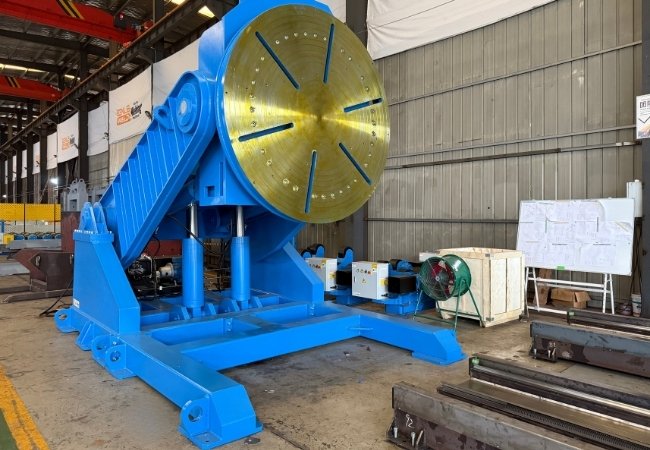
SENLISWELD offers many variations of welding positioners for industrial welding and automation. You can find 2-axis positioners, 3-axis positioners, skyhook positioners, horizontal turntable positioners, and headstock-tailstock systems.
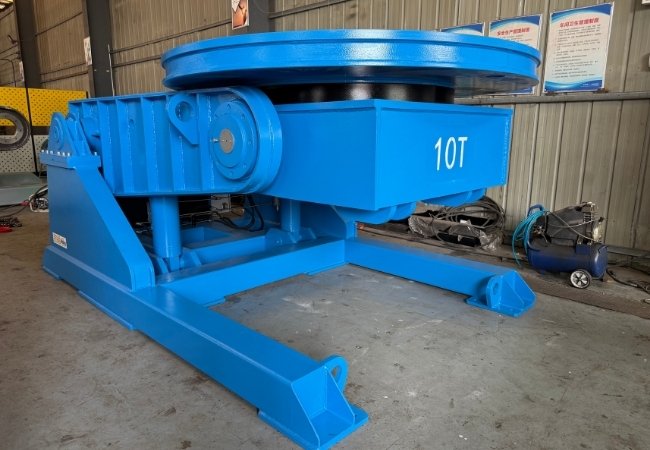
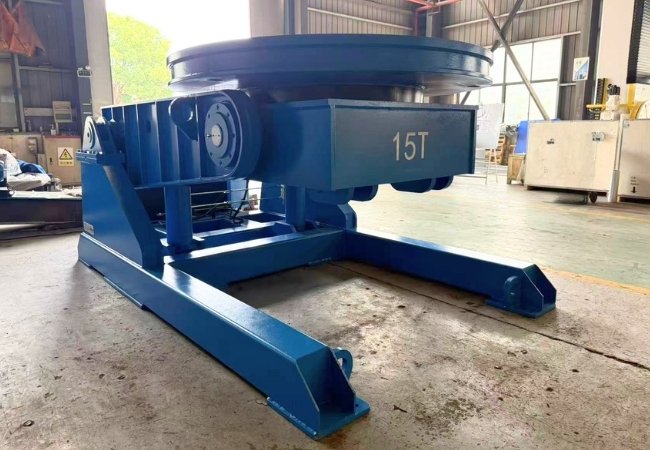
When you are considering heavy-duty welding positioners of 10T, 15T, and 25T, make sure you focus on other things rather than just the rating. You must compare the specifications of these variants to choose the configuration that suits you the best.
Focus on the following key metrics:
- Rated load
- Rotation torque
- Tilt torque
- Center-of-gravity limits
- Eccentricity
- Table diameter
- Rotation speed
- Tilt range
- Lifting range
- Motor power
- Control system
- Welding-current requirements
- Fixture options
- Safety features
- Balance options
If you are still unable to find a suitable position to meet your requirements, SENLISWELD will customise one for you. They offer positioners which can be customized to fit workpiece size, weight, and load capacities going well beyond 50 tonnes on certain configurations.
This is a great option because there are times when two different workpieces of the same weight require different positioners.
How to Choose the Right Heavy Duty Welding Positioner
You’ll need more than just price comparison when it comes to selecting an industrial welding positioner. First, you must identify your workpiece and production requirements. Then, you can decide what capacity, movements, controls, and safety elements the machine should have.
1. Calculate the Total Load
When you are told to calculate the “total load,” it means the total moving mass, not the workpiece alone. This includes:
- Workpiece
- Fixture
- Chuck
- Clamps
- Mounting plates
- Tooling
- Anything else that could be added.
If you have a 14 tonne workpiece and a 1 tonne fixture, you would need a positioner that can easily accommodate the whole unit. It shouldn’t just bear the 14 tonnes of the workpiece.
2. Check Center of Gravity
This is the point you need to consider next. You must determine where the center of gravity exists. If the center of gravity is some distance from the rotation axis, the workpiece has a greater moment load. This is especially concerning when the workpiece is tilted. Hence, you must ensure that these specifications are provided to your manufacturer before the purchase of the machine.
3. Measure Your Workpiece
Weight is only one aspect of the measurement. You must also measure your workpiece. Measure your workpiece in the following dimensions:
- Length
- Width
- Height
- Diameter
- Your mounting dimensions
- Maximum radius
- Center of gravity
You also need to consider the clearance that will be needed as the workpiece rotates or tilts.
4. Choose the Right Table Size
Your workpiece must fit securely in the given space of the table. To ensure this, you must check the table’s diameter and mounting specifications. You may need T-slots, mounting holes, a chuck, or custom-made fixtures to ensure proper fitting. A large table may not always be a good option. If you use a custom-built large positioner, it may consume more floor space and even increase your cost of production. Furthermore, it may not even benefit your production.
5. Check Rotation Speed
The type of welding you are carrying out determines the optimal speed of rotation of your workpiece. For welding in a circular motion, controlled low-speed rotation is essential. You should select a machine that provides a range of speed. This is more important than just focusing on the maximum speed. By having a variable speed control, you can easily match the workpiece movement with the welding process.
6. Consider Tilt Range
If you want to adjust the angle of the workpiece, you must consider the tilt range. Some positioners can tilt in the range of approximately 120-135°. However, there are customized systems that offer different ranges as well. You must also consider the permitted load at the tilt angle you are going to use. The maximum horizontal load may not be the same as the allowable load when the table is on an inclined angle.
7. Evaluate Fixture Compatibility
It is important to consider how your workpiece will remain secure during movement. According to your application, you may use the following:
- T-slot tables
- Three-jaw chucks
- Custom fixtures
- Clamping systems
- Mounting plates
- Headstock-tailstock supports
A properly designed fixture can make your positioner even more helpful.
8. Consider Welding Current
Your positioner requires a suitable welding current and grounding arrangement as well. Do not expect that a machine’s mechanical capacity can provide you with any insight into its electrical welding capacity. If you have to carry out high-current welding, discuss the required welding current and grounding arrangement with your supplier.
9. Think About Automation
Consider these factors when purchasing your positioner if your welding project involves robotic welding. You may need:
- PLC control
- Robot communication
- Servo drives
- Encoder feedback
- Programmable rotation
- Synchronization
- Safety interlocks
SENLISWELD ensures that their welding positioners can be PLC controlled and integrated with robots and other welding equipment. Planning this early can keep you safe from expensive adjustments later.
10. Check Installation Requirements
Heavy equipment needs appropriate installation space. Before the installation, you must consider the following:
- Weight of the equipment
- Weight of the workpiece
- Dynamic loads
- Floor capacity
- Anchoring
- Foundation
- Clearance
- Maintenance access
Your workspace must be spacious enough for loading and unloading. It should allow complete movement of the workpiece.
| Step | What to Check | Key Points |
|---|---|---|
| 1. Calculate Total Load | Include everything being rotated | Workpiece, fixture, chuck, clamps, mounting plates, and tooling |
| 2. Check Center of Gravity | Identify the load’s center of gravity | Consider extra moment load, especially when tilting |
| 3. Measure Workpiece | Check all important dimensions | Length, width, height, diameter, mounting dimensions, radius, and clearance |
| 4. Choose Table Size | Make sure the workpiece fits securely | Check table diameter, mounting holes, T-slots, chucks, and fixtures |
| 5. Check Rotation Speed | Match speed to the welding process | Choose variable and controlled speeds rather than focusing only on maximum speed |
| 6. Consider Tilt Range | Check the required working angles | Consider tilt range and allowable load at different angles |
| 7. Check Fixture Compatibility | Ensure the workpiece can be secured | T-slots, chucks, clamps, mounting plates, or custom fixtures |
| 8. Consider Welding Current | Check electrical requirements | Confirm welding current and grounding capacity with the supplier |
| 9. Plan for Automation | Check robot integration needs | PLC, robot communication, servo drives, encoders, programmable rotation, and safety interlocks |
| 10. Check Installation Requirements | Prepare the installation area | Floor capacity, foundation, anchoring, clearance, equipment weight, and maintenance access |
Applications of Heavy Duty Welding Positioners
Heavy-duty welding positioners enable controlled movement of large and awkward workpieces. Depending on the machine and control system, heavy-duty welding positioners can be used for manual, semi-automated, and even fully automated welding.
1. Pressure Vessel Manufacturing
Manufacturing of pressure vessels typically includes large and heavy parts that are cylindrical or have flanges or nozzles. A heavy positioner can rotate or tilt these heavy components, allowing you to access and properly set the welding joints.
A heavy positioner helps eliminate the need for manual repositioning of large components. If you are carrying out repetitive fabrication work, controlled positioning can help streamline production by ensuring consistent workflow.
2. Pipe and Flange Welding
Positioners have a lot of applications in pipe welding. You can use positioning systems to hold and rotate pipe sections, flanges, and fittings at a constant speed.
This type of system is very helpful in circumferential welding. To assemble long pipes, you can also use a headstock-tailstock system which can provide you with additional support.
3. Tank Manufacturing
Manipulating large tanks can be a hard task, especially after they are assembled. A welding positioner can help tilt and rotate large components during fabrication.
For extremely oversized cylindrical welds, a welding rotator may work better than a positioner that sits on a table. The ideal choice for you is based on the size and weight of the tank combined with the welding and fabrication processes being used.
4. Structural Steel Fabrication
Components of structural steel often have welds on multiple sides. You may fabricate frames, supports, beams, and braces along with complex assemblies.
Rather than repositioning a large assembly multiple times using a crane, you can use a positioner to rotate and tilt the assembly. This not only reduces welding setup time but also improves welding access.
5. Shipbuilding
You have to weld large structures and heavy components in the shipbuilding industry. Positioning equipment can aid the assembly of smaller components and subassemblies of ship structures by putting them in appropriate positions.
When using positioning equipment for shipbuilding, you need to consider the load capacity, the size of the equipment, stability, and the environment where the equipment will be used.
6. Boiler Manufacturing
Boiler fabrication can involve complex assemblies and difficult-to-access joints. A positioner can help bring these joints into better working positions.
SENLISWELD identifies boiler manufacturing among the application areas for its welding automation equipment.
7. Heavy Machinery Manufacturing
Construction, mining, agricultural, and industrial machinery often contain large welded assemblies. A positioner can help you rotate frames, housings, buckets, brackets, and other components. This is especially valuable when your workshop repeatedly produces similar assemblies.
Conclusion
A heavy-duty welding positioner can be a valuable addition for large welding projects. Rather than moving heavy components again and again, the positioner can rotate, tilt, or lift your workpiece into a convenient welding position.
With the help of a welding positioner, you not only improve weld access but also minimise operator fatigue. With consistent welds, your workflow gets streamlined, which translates into enhanced production efficiency. However, you cannot just look at a welding positioner and see if it fits a project by tonnage.
Other factors come into the equation, such as total load, center of gravity, eccentricity, dimensions, rotational speed, the range of tilt, fixtures, welding current, automation capability, installation, and safety.
Whether you need a 10T, 15T, or 25T positioner, choose the one that suits your workpiece as well as your future project requirements. The best equipment should enhance not only the ease but also the safety and productivity of your welding process.
Frequently Asked Questions
Q1: What is a heavy-duty welding positioner?
A heavy-duty welding positioner is a piece of machinery that simplifies the welding process for large, heavy pieces. It minimises the human effort required to reposition the workpieces during the welding process. These machines use mechanical advantage to help you hold, lift, rotate, and tilt workpieces for better access to joints.
Q2: Why is a heavy-duty welding positioner useful?
Large and awkward pieces are a challenge to maneuver and can cause welder fatigue. Heavy-duty welding positioners help improve welding efficiency by eliminating the need to move the workpieces. This reduces the repositioning time, supports repeatable positioning, and increases the weld position access.
Q3: What is the difference between a welding positioner and rotator?
A welding positioner is a device that holds pieces either in a loose state (on a table) or a fixed state (in a chuck or fixture). Most welding positioners are capable of rotating or tilting pieces. A welding rotator typically rotates pieces that are cylindrical around a longitudinal axis.
Q4: How do you select an appropriate welding positioner capacity?
While selecting positioning equipment, you should not rely on the maximum tonnage capacity. You need to consider fixture and workpiece weight, center of gravity, eccentricity, dimensions, tilt angle, rotation torque, and the manufacturer’s load chart.
Q5: What do 10T, 15T, and 25T welding positioners mean?
They relate to the load ratings within defined parameters. A 10T model can only handle the labelled weight, while 15T or 25T can withstand higher loads. However, geometry and eccentric loading still need to be considered.
Q6: Can a heavy-duty welding positioner be used with a robot?
Yes, automation for industrial welding positioners can be achieved by integrating controls, PLC, safety, feedback, and synchronization systems. However, you must check the compatibility of the selected equipment with the particular robot to be automated.
Recommend Reading
Types of Welding Positioners – SENLISWELD
3-axis Welding Positioner – SENLISWELD
Applications of Welding Positioners – SENLISWELD
Ship Welding – SENLISWELD


 EN
 ES
 RU
 JA
 FR
 PT