

Applications of Welding Positioners: Improving Welding Quality and Efficiency

Welding Positioner
- Does the welding manipulator suit every type of welding process applied in thermal power plants?
The manipulators also have provisions for handling different welding processes, like TIG, MIG, and arc welding required in various applications of thermal power plants. Due to this versatility, they can be deployed on a wide range of applications within the plant, starting from boiler construction to pipeline repair, with high-quality welds that are guaranteed to meet the standards of the industry.
- What features should one look out for when choosing a welding manipulator meant for heavy industrial applications?
Selection criteria for a welding manipulator used in heavy industrial applications would include system load capacity, reach, and flexibility, plus the type of welding the system will support. Productivity and safety-enhancing options would also include programmable memory settings to operate the manipulator for repetitive tasks, remote operation of the manipulator, and the ability to interface with existing automation systems.
Different Types of Welding Positioners
These are also versatile tools that might come in various types to fit the bill of any need within the welding industry. Here are three such specific types: hydraulic welding positioners, 2-axis positioners, and 3-axis positioners.
Hydraulic Welding Positioners
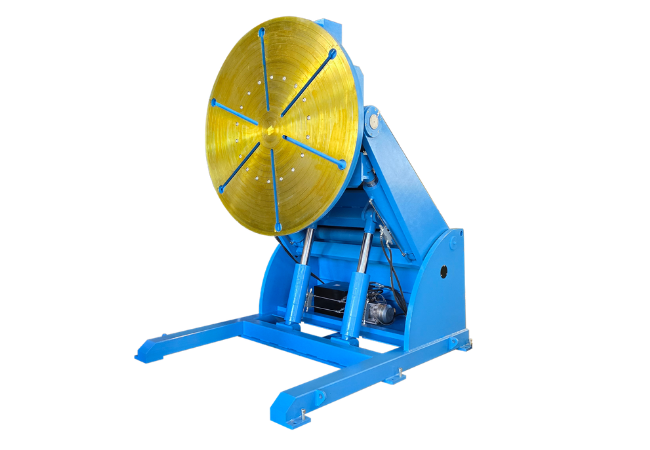
Hydraulic Welding Positioner
They are powerful, offering great control in the positioning of heavy and large workpieces. They achieve lifting and rotation through hydraulic systems, which make them very efficient in handling very heavy loads that may not be managed by other positioners.
Reliable hydraulic control valves help manage hydraulic flow direction and actuator operation, supporting accurate movement control in hydraulic welding positioners.
This makes them very popular in industries dealing with large-scale manufacturing and heavy materials, such as shipbuilding or heavy equipment manufacturing.
2-Axis Welding Positioners

2-axis Welding Positioner
These allow for movement about two different axes. This generally means they can tilt and rotate the workpiece.
This capability enables the welders to reach the top and sides of the object without manually having to reposition it, especially helpful on complicated jobs in precision industries such as automotive or aerospace.
3-Axis Welding Positioner

3-axis Welding Positioner
It takes it further by including another degree of freedom: they can rotate and tilt while adding the capability to lift the workpiece linearly. This third axis opens many more possibilities of access and flexibility with the workpiece, thus enabling very complex welding jobs to be done with greater ease and accuracy.
The 3-axis positioners typically find their application in modern manufacturing setups where accuracy and versatility become paramount-for instance, advanced engineering applications or the manufacture of intricate mechanical parts.
Each of the positioners provides key gains in productivity, safety, and quality due to better access, control, and handling in welding various forms and materials.
Role of Welding Positioner in Welding
Among the most important things a welding positioner is supposed to do is to improve the quality, efficiency, and safety in welding. A welding positioner mechanically holds an unwieldy or heavy workpiece in place and manipulates it to an optimal position where welding can take place; this frees up a welder to work on his technique without having to be concerned with positioning the pieces.
The result is better accessibility to joints, which can be rotated or tilted to optimum angles for welding. This not only quickens the welding process but also minimizes the physical strain on welders, thus greatly increasing workplace safety.
Furthermore, this positioner holds the workpiece in a steady state to ensure each weld quality is consistent. This consistency is critical in many fields, such as automotive, aerospace, and construction, where the precision of welding bears reliability.
What is the Purpose of Welding Positioners?

Welding Positioner Improves Welding Quality
Improved Weld Quality
The quality of welds is improved since a welding positioner contributes in many ways to good quality welds. A welding positioner can be controlled with regards to the placing and orientation of the workpiece. Such control is important since consistency in positioning ensures application of weld beads accurately, therefore reducing the possibility of defects such as uneven welds or improper penetration.
The facility for mechanical rotation or tilting of the workpiece to maintain the weld in a work position is usually fitted onto the positioner-the most preferred being horizontal. This preferred position allows better control of the weld pool, which is responsible for the strength and uniformity in a joint.
Use of a welding positioner minimizes human error and variability associated with handling by operators. Welders can devote all their attention to the weld application, instead of fighting the weight and balance of the components.
The speed of welding is improved not only by this but also quality in general appearance and integrity of the weld itself. This is particularly important in industries where the strength of the weld determines the safety and durability of the structure. Common examples are in construction and manufacture.
With the addition of a welding positioner into the workflow, companies will realize great improvements in the quality of the welds. Not only in the strength and durability of the welds, but also in their aesthetic consistency, which can be critical for consumer-facing products.
Such precision control with positioners assists in ensuring that each and every welding takes place at the best possible conditions. Hence, fewer defects and reworks would result, thereby saving lots of time and resources before giving high quality to the finished product.
Increased Productivity

Welding Positioners Increase Productivity
The welding positioner contributes much to productivity in welding processes because it is capable of automating and smoothening the handling and positioning of workpieces.
This allows for:
Continuous Operation
Welders can work uninterruptedly because the positioner rotates the piece in such a way that the process keeps running without unnecessary starts and stops.
Faster Welding Speeds
Optimum positioning enables welders to weld at higher speeds since the time used to manipulate the workpiece is minimized and more time is actually spent welding.
Setup Time Reduction
With a positioner, fast and precise adjustments minimize overall setup time for each welding process.
Moreover, a welding positioner minimizes physical demands on welders since there will be no lifting, holding, or even turning of heavy pieces by hand. That reduction in manual labor not only increases the speed at which welding is carried out but also diminishes worker fatigue that may lead to:
Consistency in Welds Throughout the Day
Less physical strain means welders can maintain high-quality work even during long shifts.
Less Downtime
With fewer injuries and less fatigue, the time for operation becomes longer as there is less downtime.
The welding positioner helps a company iron out its workflow and save on labor costs, raising the output bar in welding operations. Therefore, these benefits collectively work to achieve higher productivity, better project turnarounds, and thus make the welding positioner a very vital instrument in most modern manufacturing environments.
Ergonomic Benefits
A welding positioner enhances working conditions for welders. The special equipment reduces the amount of physical labor that is typically spent by hand in welding. The main ergonomic contributions involve a reduction in the following:
Lifting and holding, where welders are not under obligations to lift or hold at heavy or odd-shaped components; this saves them from fatigue and stress on muscles and bones.
Optimal Workpiece Positioning
This positioner allows the workpiece to be manipulated into the most favorable angle for welding, thereby affording the welders the capability of working in a more comfortable, natural posture without bending and stretching around awkwardly.
Besides, these ergonomic improvements contribute to health and well-being for workers. Since the positioner allows for a more comfortable work position, it reduces occupational injuries such as back pain and repetitive strain injury from common welding tasks. Benefits include:
Increased Worker Satisfaction and Morale
A better comfort level in the workplace results in happier employees. This can contribute to an overall improvement in job satisfaction and lower turnover.
Welders Have Longer Career Longevity
Save the physical wear and tear on welders by possibly keeping them in their trade longer, while avoiding long-term potential health problems.
The introduction of a welding positioner to any welding configuration is going to not only raise the quality and speed of the work but also make a much safer, more ergonomically friendly workplace. This aspect of ergonomics is important for maintaining a healthy workforce but can also have significant positive effects on productivity and operational costs.
Versatility for Different Weld Types

Welding Positioner Provides Welding Versatility
The welding positioners greatly enhance flexibility in welding processes, hence enabling welders to handle a variety of types of welds effectively in different projects and industries. By offering the capability for rotation and tilting of workpieces, positioners allow the welders to access all sides and angles of a component without manual repositioning of the set-up.
This flexibility is indispensable in various weldings-from flat to horizontal, to more complicated vertical and overhead welds. These types of welds are challenging to carry out and, if not done rightly, will lower the quality of the weld.
The possibility of positioning a workpiece for the most favorable angle for a particular type of weld greatly enhances the quality of the weld itself but also extends the capabilities of projects that can be taken in by a welding workshop. This includes:
Complex Assemblies
Large, intricate assemblies that may require multiple welds in a variety of angles can easily be manipulated by positioners.
Thin Sheets and Thicker Plates
By adjusting the positioners, depending on specific needs of each material, be it proper weld penetration and strength.
Enhanced Safety
Positioners are known to make many contributions toward improved safety in the welding environment by reducing the physical risks that come along with doing most welding tasks manually. Here’s how they help:
First, welding positioners eliminate the need for welders to have to lift, hold, or otherwise turn large and/or unwieldy objects by hand. While this eliminates many injuries from handling heavy materials, it also minimizes the chances of slips, trips, and falls common from the maneuvering of large items around a workshop. Using a positioner allows for the easy and safe manipulation of the workpiece into the ideal position for welding, without physical strains.
Second, welders can maintain a safer distance from the heat and sparks of the welding process owing to the better positioning of the workpiece. This leads to decreased exposure to harmful fumes and ultraviolet light, which is one of the main health hazards faced during welding. Positioners help in maintaining a clean and organized workplace by confining the welding action to a particular controlled area, hence reducing workplace accidents.
Accessibility to Hidden Areas
Welding positioners will definitely help in accessing those hidden areas in a workpiece for welding. These devices have the ability to position the workpiece in question with great precision and can be rotated or tilted to expose every single angle that may be needed to be welded. Here is how they improve access:
Positioners eliminate the need for the welder to work around large or irregularly shaped objects by rotating and tilting the workpiece. As a matter of fact, even the most inaccessible areas can be presented directly in front of the welder. For this reason, areas of a part that would otherwise require special set-ups or manual repositioning can easily reach. Hence, the same quality welding throughout can be attained.
This also means that the welder can give the same amount of detail to all parts of the workpiece, irrespective of the position. For this reason, welders are able to apply identical methodologies and exactness to each part of the weld for better overall integrity and look of the finished product. This is important in projects where every single weld can determine the strength of the entire venture, such as in structural engineering or the manufacture of vehicles.
Since the welding positioners make access to all parts of the workpiece easier, besides making the job less demanding and safer for welders, they strongly enhance the quality of the final welds.
Efficient Use of Space
Positioners minimize the need for large open areas otherwise necessary for manually manipulating and welding large or unwieldy items by optimizing handling and access of workpieces.
For one, positioners can fit compactly into a workshop layout, holding securely onto the workpiece in one place and providing the ability to rotate and tilt it to any needed angle. In turn, this means that welders do not have to move around quite as much, nor do they need to reposition the workpiece manually. Instead, the positioner does the heavy lifting and moving so that the actual footprint required for each welding task is minimized.
It allows many welds in one setup without taking space for repositioning either the item or equipment by rotating the workpiece. It is also due to the exploitation of vertical and rotational space that operations can be stacked more closely, thereby increasing workflow efficiency, allowing more tasks to be performed within an even smaller area.
Not only will this make the welding shops more organized and uncluttered, but it will also increase overall productivity, allowing smoother workflow in a safely maximized space.
The Bottom Line
The welding positioners avail much value to the welding industry in enhancing safety, improving weld quality, and heightening productivity through a myriad of applications. From hydraulic and 2-axis to 3-axis positioners, each contributes its special advantages to meet the peculiar requirements of several industries, from automotive to aerospace and beyond.
These devices will further enable the business to undertake even more complicated projects, as they have the ability to manipulate and hold workpieces in optimal positions with great precision. This therefore minimizes the level of manual labor involved and improves efficiency in operations. A perfect welding positioner can really boost the activity of any welding operation; thus, here are the reasons for investing in one-a very wise decision a business can make to keep it competitive in the modern market.
Frequently Asked Questions (FAQs)
Q: What benefits do the welding positioners offer to the medium and small workshops?
A: Welding positioners can manifold the efficiency of work in a small workshop while making the working much safer. The automation this machine provides in handling workpieces at site for more precise positioning saves manual labor that might result in high-quality welds, and completion of more projects with the same effort takes much shorter time.
Q: In what ways do welding positioners improve industrial productivity?
A: Welding positioners make the process of welding easier because they hold a consistent welding angle, provide faster operations, and free the welder to concentrate on technique rather than on positioning. The result is quicker production and higher volume.
Q: Are there welding positioners applicable for any other welding method?
A: The welding positioners can be used for MIG, TIG, and stick welding, among other methods. They adapt very well to several setups of welding equipment, which makes them flexible in different applications of welding.
If you work with complex geometries, then a welding positioner that can achieve multi-axis rotation with precision is what you need. A 3-axis positioner may just about be right for this, as it allows adjustment in more than one dimension. This could be important in getting the right angles on intricate shapes.
Q: How does using a welding positioner affect the overall cost-efficiency of welding projects?
A: A welding positioner can significantly increase cost-efficiency by reducing labor costs, need for reworks minimizing due to fewer welding errors, and shortening of project timelines. All these reasons combined reduce the overall cost of welding projects while improving the quality of the output at the same time.


 EN
 ES
 RU
 JA
 FR
 PT