

Types of Welding Positioners
Welding is an art-one that requires precision, much patience, and considerable expertise. However, it is also true that having the proper gadgets and tools makes all the difference. A vital gadget used in a welding operation is a welding positioner. These handy gadgets are used to hold and rotate the workpieces during the welding operation, thereby smoothening the whole process and making the job easier and faster. In this paper, we shall take a closer look at various types of welding positioners.
This will help in understanding the options available, from benchtop models to large floor-mounted units, and choose the appropriate positioner for your projects, whether it’s a small part or large assemblies.
With that said, let’s get into specifics and take a closer look at some of the many types of welding positioners you could use in your work.
Welding Positioners
Welding positioners serve to hold, rotate, and tilt the workpiece accordingly. They allow for greater access by welders to various parts of it without necessarily changing positions manually or that of the item being welded.
These appliances make the welding process easier and more efficient, as they also contribute to good quality welds by providing consistent and stable positioning.
A welding positioner’s purpose is to provide conditions for working on a piece from the most favorable angle by maintaining even and accurate welds. This can allow the workpiece to be rotated as much as 360 degrees, so that even the least-accessible places can be properly welded.
This is especially useful in welding circular parts, like tubes and pipes, or geometries where welding should be performed from several angles.
A welding positioner keeps the welder in an easy and safe working position through the process. This will reduce fatigue and also the possibility of repetitive strain injury.
Also, since the workpiece can be set at the best angle for welding, there is less likelihood of weld defects, meaning stronger, more reliable finished products.
Types of Welding Positioners
Following are some of the most common types of welding positioners:
1.2 Axis Positioner
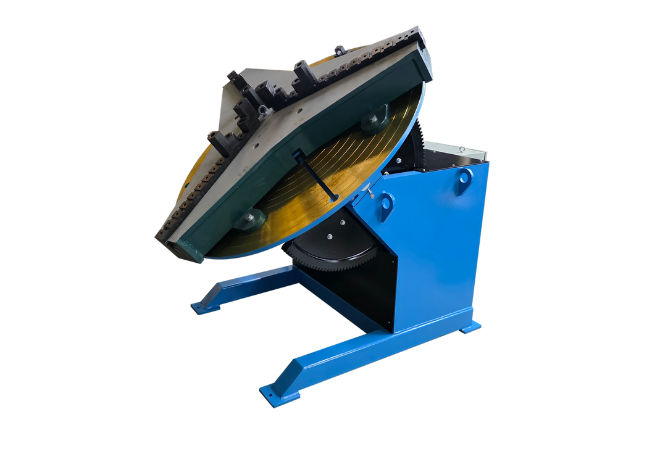
2-Axis Positioner
The welding system capable of operating in two directions-tilting and rotation of the object being welded-is called a 2-axis positioner.
This flexibility meets the accommodation needs of the welder through staying in one position, hence making the welding easier and conducive to increased efficiency. Variety in shapes and sizes of materials can be handled by this positioner and is thus versatile for various welding tasks.
A 2-axis positioner improves the quality and speed in welding. It stabilizes the workpiece, which means welds can be done more accurately with less manual fiddling of the workpiece. This, in turn, leads not only to a more consistent quality in the weld but also a productivity boost due to the faster completion of welding jobs.
The advantages with the 2-axis positioner include increased efficiency, improvement in the quality of the weld, and a reduction in labor costs. It works with cumbersome, irregularly shaped objects to weld by hand. Automation of welding saves the welders from the physical strains and thus minimizes errors for better performance in general welding operations.
2.3 Axis Positioner
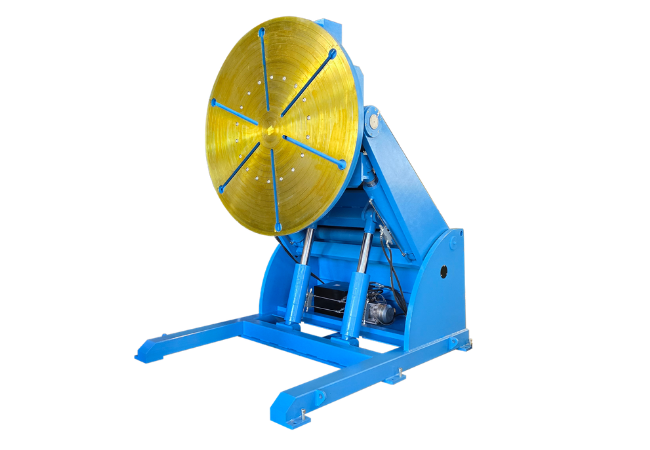
3-Axis Positioner
Such positioning equipment enables the 3-axis movement, which can be lifted, tilted, and rotated. All that can reach the perfect spot for welding with great accuracy. Rather versatile, it can be adjusted to handle materials of different sizes and weights, which is essential in some complex welding tasks.
Use of 3-axis positioners within welding operations increases the preciseness of the process and the efficiency. They do this by allowing welders to work on places that are difficult to access without having to manually reposition the workpieces. This saves time and assures quality because the angle and position of operation are just ideal throughout the process.
The advantages of a 3-axis positioner are that it enhances accessibility and control while improving the productivity of welding work. This is highly useful in complex welding jobs where accuracy is paramount. The flexibility regarding workpiece size and the consistency in welding quality make it one of the indispensable pieces of equipment in any sophisticated welding system.
3.Skyhook Positioner

Skyhook Positioner
The Skyhook positioner, a variation of 2-axis positioners, is designed in such a way that it can perform specific welding and handling jobs at great accuracies in positioning objects. For one to select appropriate Skyhook positioners, special consideration must be put on the size and weight of the materials to work with.
The right choice means the ability to efficiently and safely operate the load, whether large and heavy or small and more delicate.
Various ancillary features can be applied, too, to Skyhook positioners to enhance functionality, including variable rotational speeds when fast or precision work is required, tilt angles to orient components appropriately, and controls from simple buttons to sophisticated touch screens or remote controls.
These features make the Skyhook positioner adaptable to a variety of welding requirements, thus offering ease and efficiency in the process.
4. Horizontal Turntable
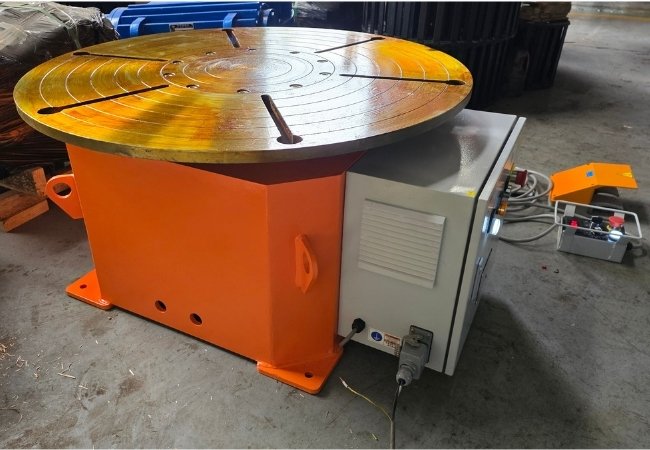
Horizontal Turntable
A horizontal turntable is applied in welding, which holds and rotates heavy workpieces. The work can be reached from different parts by the welder without having to move around it. This tool can bear very heavy loads, thus making the operation of welding big and cumbersome objects easier. Its ability for rotation will allow it to find the best angle for welding, improving the quality and comfort of work.
It is fitted with adjustable speed and direction of rotation; sometimes it is the height, hence versatile for welding tasks. Work can rotate either clockwise or anti-clockwise. It, therefore, aids in achieving precise welds and is ideal for complex projects.
The horizontal turntable has so many advantages. The welding operations are performed very efficiently and safely. It reduces the manual handling of heavy items as it is done by turntables; hence, workers do not get exhausted easily. The quality of welding would be higher as the workpiece gets proper and slow movement.
5.Headstock Tailstock Positioner

Headstock Tailstock Positioner
The headstock tailstock positioner moves the parts along in the horizontal axis, making it ideal for handling long items such as axles, beams, and benches-pretty common in automated processes.
This normally comprises one headstock unit, which has a servo motor for rotation of the table, and one tailstock unit with a bearing that supports the load. This helps in smoothly rotating big and heavy pieces without putting excessive pressure on the gearbox.
These headstock tailstock positioners can be customized further into a number of variations to suit a broad range of production requirements. For instance, two of these positioners with a robot positioned between them can be combined to have two workers loading and unloading parts while the robot is welding.
This setup not only boosts productivity but also allows the work flow to be regular, since continuous loading and unloading can be conducted while welding.
Comparison Table of All Types
| Positioner Type | Key Features | Workflow with Operator |
| 2 Axis Positioner | Tilts and rotates workpiece; 130-degree tilt capability | Operator sets workpiece, controls tilt and rotation |
| 3 Axis Positioner | Adds lifting to tilting and rotating; greater flexibility | Operator can lift, tilt, and rotate without repositioning |
| Skyhook Positioner | Advanced tilting and rotating, handles complex tasks | Operator can manipulate large/awkward pieces easily |
| Horizontal Turntable | Rotates workpiece on a single plane; high weight capacity | Operator places workpiece, then rotates for access |
| Headstock Tailstock | Operator loads/unloads parts; rotation allows easy access for welding | Operator manages setup and removal; positioner rotates for welding access |
The right welding positioner is everything when it comes to quality and efficiency in your welding projects. From handling small parts and long beams to pipes, specialized setups are designed for any particular need.
Remember that the success of any welding depends on a welder’s expertise but also on proper equipment. That is where SENLIS WELD comes in.
As the leading manufacturer of welding positioners, SENLIS WELD offers a wide variety of high-quality, reliable, and easy-to-operate positioners designed to address every single demand of welding.
Contact SENLIS WELD today for the best positioner for your job at hand and improve your weld.


 EN
 ES
 RU
 JA
 FR
 PT