

Many people think that a weld done between two metals is not strong and that it’s just a weak joint between both. So, is it? There is no true answer. Sometimes, the weld is as strong as the base metal, and sometimes it doesn’t. You may ask how we figured this out.
Well, there is a factor in welding called weld joint efficiency, which determines the strength of the weld. We will explain in detail about what is joint efficiency, how to calculate it using a formula, and everything related to it.
What is Joint Efficiency?
The welding joint efficiency is basically a factor that determines the strength of the weld relative to the base material. You can say that it checks the reliability of the weld against that base material. It is a very important factor to check welding quality.
Since there are lots of welding defects that can occur on the welds like slag inclusion, porosity, undercutting, and more, they decrease the strength of welds.
So, without any destructive or non-destructive welding inspection, the weld joint efficiency factor is calculated. Based on that, the welders fix the strength issue to make it similar to the base material by rewelding.
Why is Joint Efficiency in Welding Important?
Welding joint efficiency tells you how strong and reliable the structure is. The stronger the welded joint is, the more the reliability in performance and strength of any structure.
If we talk about the manufacturing and construction industry, joint efficiency in welding minimizes structural failures. If the welding is done poorly and the joints are not strong, there is an increased chance of accidents and mishaps.
Joint efficiency has a huge impact on the material cost and usage. Efficient welds don’t allow the use of thick material. A weld is efficient when you use a thinner layer that doesn’t compromise on the strength. Resultantly, you will see a reduced use of metal, less waste, and less expense since you are using less material.
As we have mentioned before, an efficient joint is also important in the welding quality inspection. The weld inspectors, through the joint efficiency formula, calculate how well the welding is done. It shows the skills of a welder and the reliability of the joint as well.
Moreover, structures having efficient joints need less maintenance and repairs, which saves not only time and effort but also money. This has a great impact on the industries that spend too much money on upkeep.
What are the Factors Affecting Welding Joint Efficiency?
There are a few factors that may have a direct or indirect effect on welding efficiency. So, it’s important to know what these factors are to improve the quality of the welds. Some of the factors are:
1. Welding Process
Surprisingly, the welding technique plays a great role in welding efficiency. As compared to conventional stick welding, methods like metal inert gas welding and tungsten insert gas welding generate higher quality of welds. If you automate these processes, the efficiency is increased even more.
2. Type of Material
First, it’s important that the base material and the filler material are compatible with each other. Secondly, every metal reacts uniquely to heat and welding.
Why? Because each has a different value of heat conductivity and melting point. Besides, various metal properties determine the strength of the weld. Steel and aluminum are great in this regard.
3. Joint Type
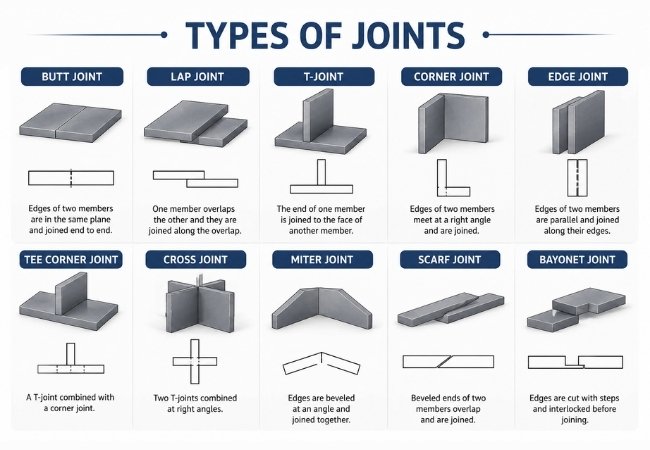
The joint type is also another determining weld joint efficiency factor. You must prepare the joints properly and see the edges and alignments before welding. The welding quality of lap, butt, and fillet joints is the best.
4. Heat Input
The heat input also affects the material microstructure and weld strength. The heat should not be too excessive nor too low.
Keep the heat input controlled as it decreases discontinuities, distortions, and metal weakening that ultimately reduce the efficiency of the joint.
5. Welding Position
Overhead welding results in bad welding quality, whereas flat-positioned welding gives much better results in terms of welding efficiency. So, the welding position also matters when you want to achieve good quality welding.
6. Pre and Post Welding Treatment
Pre and post weld treatments contribute majorly to the efficiency of the joints. Cleaning, stress-relieving, and preheating remove metal contaminants and lessen residual stress, resulting in stronger welding joints.
7. Environment
Environmental factors, including wind conditions, humidity, and temperature, also affect welding efficiency. For instance, when the humidity is high in the air, it leads to entrapped hydrogen in the weld.
8. Welder Skills
An experienced welder is one of the primary factors that improves weld quality.
How? A skilled and experienced welder knows how much heat input is required, his speed will be controlled, and he will weld with the appropriate technique to reduce defects and increase efficiency.
Weld Joint Efficiency Factor
This factor tells you the strength of the material after it’s welded. Understanding this factor is essential since welding has applications in different industries where high-stress and load activity.
The weld joint efficiency factor is the ratio (0-1) or a percentage (0%-100%). If the weld efficiency has a 1 or 100% value, it means that the weld is as strong as the base material.
When the factor is less than this value, it indicates a less strong joint compared to the base metal. It tells us there are faults, weaker points, or some other limitations causing this. This factor is also important to find out the best working pressures and welding safety.
How to Calculate?
The weld joint efficiency factor is calculated through a joint efficiency formula, which is
Efficiency factor= Strength of welded joint/Strength of the base material
The factor comes out by dividing the strength of the welded joint by the strength of the base material. The value that comes as an answer determines the joint efficiency without unneeded wastage of material and overdesign.
Components of Joint Efficiency Formula
| Strength of the welded joint | Strength of the base material |
| It is basically the strength of the welded layer that tolerates forces without any damage. This is based on the welding quality, welding defects, and joint preparation. | The strength of the material before welding for a comparison standard. |
Let’s see some practical examples where the weld joint efficiency factor may be used for designing.
- If the pressure vessel has a joint efficiency of 0.85, it means it will have a thicker wall than the one having a value of 1.
- When the efficiency factor of the pipeline welding is high, it means they can withstand high pressures and loads.
Efficiency Importance in Engineering
Higher efficiency makes sure that the engineered structures are reliable, safe, and affordable. Architects and engineers use this factor to calculate welding material cost and usage. Besides, it helps stick to the safety codes during the engineering process and identify areas of improvement.
Role of Efficiency Factor in Welding Standards
Regulatory bodies like AWS and ASME offer guidelines for the appropriate weld joint efficiency factors on the basis of inspection, application, and material used. When you adhere to these standards, it will make sure that the welding process is consistent and industry-compliant.
Ways to Improve Joint Efficiency
Now that you have known the importance of joint efficiency, it’s essential to pay more attention to it. You need to improve it in order to make durable, stronger, and long-lasting structures.
If the welders, inspectors, and manufacturers focus on the quality at each welding step, it will be a lot easier to achieve higher efficiency and minimize the chances of failures.
Some of the ways to improve joint efficiency in welding are:
1. Select the Right Welding Technique
Instead of stick welding, use advanced welding methods like TIG or MIG welding because they produce cleaner, more consistent welds.
If you are dealing with critical applications, it’s advisable to use automatic or robotic procedures to reduce errors as much as possible. Also, check that the welding technique you’re using is compatible with the materials you are working with.
2. Appropriate Joint Design
Select the right type of joint design before welding. Compared to lap and corner joints, butt joints give a higher joint efficiency value. Because they offer good load distribution.
Make sure that the joints are prepared, like beveling, alignment, and cleaning, to help stronger welds. You must minimize the stress concentration and increase load-carrying capacity by optimizing the geometry of joints.
3. Use High-End Materials
As mentioned earlier, it is quite important to select the base and filler materials that are compatible with each other. Restrict using metals with impurities and physical and chemical defects as they may weaken the welding.
For better joint performance, it’s advised to use filler material having high tensile strength, as it will result in better and stronger welds.
4. Perform Careful Inspections
Do a thorough inspection before welding to detect potential problems, including contamination of the surface and misalignment. Meanwhile, conduct a post-welding inspection to make sure that the needed strength and welding quality is maintained.
5. Control Heat Input
Warping, discontinuities, and excessive distortion can be avoided by appropriate heat inputs. Besides, you need to control the speed of welding to attain seamless penetration and constant bead appearance. To reduce material weakening and improve joint efficiency, you must avoid overheating.
6. Pre and Post Weld Treatment
Preheat high-strength and thick materials to minimize thermal gradients and reduce residual stress. Whereas, the post-welding treatments further decrease the residual stress and help improve the welding strength.
7. Ensure Cleanliness
Make sure to clean the surface of the base metal to get rid of contaminations, dirt, oil, and paint. It’s important to consider the right cleaning methods, like grinding, chemical cleaning, and wire brushing, to prepare the joints appropriately.
8. Use Advanced Equipment
It’s important to get high end machines for welding that ensure precise welds through controlled heat input, voltage, and current.
Use spatter-free MIG welding machines and automatic systems to reduce the chances of defects. Regularly maintain the equipment for seamless performance.
9. Skilled Welders
Keep a check on the welders who are skilled in their work and have proper certificates and welding understanding.
Offer training programs and arrange workshops to train the workers based on the advanced welding trends. Pay a special focus on attention to detail at each and every welding process step.
10. Monitor Environmental Factors
Maintain welding workspace and keep an eye on the humidity level, temperature changes, and wind effects.
Employ shielding gases and certain protection measures to minimize contamination during and after the welding process.
Welding Standards and Joint Efficiency
The American Welding Society and the American Society of Mechanical Engineers (ASME) give some guidelines to check welding quality, joint efficiency, and inspection.
You can use them for various industries, including construction, manufacturing, oil & gas, and aerospace industries.
The following are some of the guidelines:
- ASME boiler and pressure vessel code
- ASME B31 series
- AWS D1.1 structural welding code for steel
- AWS D1.2 structural welding code for aluminum
- ISO standards (9606 and 15614)
- American Petroleum Institute standards
Following the rules and regulations provided by ASME, API, AWS, and ISO helps in cost optimization, safety of the welders, seamless welding process, and strong welds. So, it’s important that manufacturers reinforce these rules and make sure the welding process is completed based on the guidelines provided by the mentioned authorities.
Conclusion
So, joint efficiency is the factor that determines how strong and reliable the weld is. It helps figure out the longevity of the weld besides giving you the idea that the final weld is complete without defects or minimum defects.
You can say that it checks the reliability of the weld against that base material. It is a very important factor to check welding quality.
Since there are lots of welding defects that can occur on the welds like slag inclusion, porosity, undercutting, and more, they decrease the strength of welds.
Without any destructive or non-destructive welding inspection, the weld joint efficiency factor is calculated through the weld joint efficiency formula, and based on that, improvements are made.
However, there are certain ways mentioned above to improve this joint and welding efficiency. So, you must make sure to implement those ways and minimize welding defects.


 EN
 ES
 RU
 JA
 FR
 PT