

Applications of Welding Manipulators

Welding Manipulators
Manipulators have today become the most important factor in modern times because they ensure better accuracy and speed in every industry. These special machines facilitate complicated and time-consuming welding to ensure a quality weld with consistent reliability. In industries such as aerospace, automotive, and heavy machinery manufacture, manipulators make the work easy and safe while reducing manual intervention in the production process.
Businesses that integrate welding manipulators into their production will directly benefit in sales due to increased productivity and product durability.
In addition, by automating such intricate and dangerous tasks, these machines expedite production and allow the maintenance of stringent quality standards essential for competitive manufacturing.
Let’s understand the multiple applications of welding manipulators and how they are helping different industries.
Welding Manipulators

Welding Manipulators (Column and Boom)
Welding manipulators are engineered mechanical installations designed to accommodate and optimize the welding process, especially in industrial applications. They are not welding machines but come into use by positioning the head of welding and mostly the workpiece in the best position, hence making the welding process faster, more accurate, and safer.
Positioning Capability
Welding manipulators can move the welding head over a workpiece in any of several directions-vertical, horizontal, or in a circular path. This same possibility also provides for more precise positioning, which is greatly needed to achieve high-quality welds on assemblies either quite large or complex.
Increased Reach and Accessibility
Especially useful in large projects requiring welds, their implementation is seen in the building of ships or large containers where welds are to be implemented in a place that is not accessible manually.
Constant Quality of Weld
Because of the constant maintenance of the welding angles and distances, manipulators help to make the welds consistent and of better quality throughout the work. This reduces the defect possibility and reworks.
More Safety
The welding manipulators can also work in hazardous environments or handle dangerous materials, reducing injury to human operators, especially in very hot, toxic, and tightly spaced environments.
Programmable and Automated Operation
Most modern manipulators boast advanced controls and programming possibilities for automated welding operations. They provide great opportunities for integrating automated welding systems to increase production speed and decrease labor costs.
Compatibility and Integration
They can also be fitted with different types of welding heads and equipment; hence, they can be used in several techniques of welding, such as MIG, TIG, and submerged arc welding. This makes them very valuable in a range of manufacturing processes.
Durability and Load Carrying Capacity
Designed to handle heavy and at times odd shapes, the manipulators in welding are planned to be rugged, taking industrial strains and tending to considerable weights.
These features in turn tend to enhance efficiency and safety of the weld, improve production capability, and increase quality control in a manufacturing setup by welding manipulators.
Applications of Welding Manipulators
One of the many ways in which industry approaches fabrication and assembly is through welding manipulators. In many applications today, manipulators have indeed become extremely versatile solutions to a number of welding challenges.
These devices are important in those sectors where both precision and scale come together, thus enabling more complex and far-reaching welding tasks with much higher levels of accuracy and efficiency.
Applications range from the tiniest workshops up to the largest industrial settings. It also goes to show that welding manipulators are adaptive and a very essential player in the modern day manufacturing process.
Shipbuilding
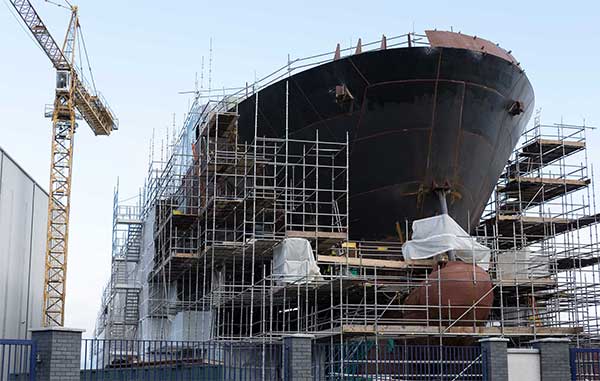
Ship Building
Column and boom welding manipulators are the heavy lifters in the process of shipbuilding, column, and boom welding manipulators. These manipulators handle big and tough jobs when it comes to welding, a job too big to be performed by a human welder due to distance or risk involved.
This is how they might affect the process of shipbuilding:
Reach and precision
Long booms and tall columns position the welding head in just the right spot amidst the intricate framework that comprises a ship’s hull. This is really what big reaches and precision are needed for: building strong, seaworthy vessels.
Speed
Since these manipulators enable shipbuilders to speed up the whole welding process, it therefore implies that ships can be constructed in record times. Consequently, this cuts down on build times and permits the yards to accept more projects or deliver ships on tighter schedules.
Consistency and Quality
Each weld in shipbuilding can be duplicated with the same quality consistently, as the strength of every joint is important; automatic control over column and boom manipulators ensures this consistency and guarantees a robust and reliable final product.
Safety
Welding, particularly in mega structures such as ships, may be hazardous due to the heat, smoke, and possibility of falls. Manipulators reduce dangerous positioning by welders, hence minimizing risks in workplaces.
Aerospace
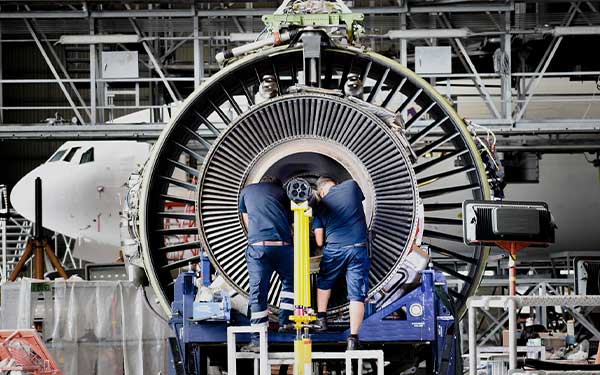
Aerospace Industry
Column and boom welding manipulators continue to play an important role in maintaining the high levels of precision and quality that aerospace components and structures have demanded. Here’s how they are applied:
Fabrication of airframe components
Large sections of aircraft frames, including the fuselage and wings, are manufactured with the help of column and boom manipulators. These devices enable consistent, high-quality welds across large and complex parts, ensuring structural integrity and compliance with strict aerospace standards.
Aerospace engines are the most complicated constructions; their materials need special methods of welding. Column-and-boom manipulators serve for the precise positioning of a welding head in the course of assembling and repair of the parts of engines, where even minor errors can turn out to be of the highest importance.
Manufacturing of Landing Gear
The landing gears of an aircraft have to bear very extreme stresses, and such a fabrication process requires very exacting specifications. Manipulators in welding help to attain the robust welds needed on such critical components for durability and reliability.
Spacecraft Welding
Spacecraft assembly includes welding large metal sections and fragile pieces that need to hold up under extreme conditions in space. Column and boom manipulators can be versatile with control for precision at high-consequence welds.
Maintenance and Overhaul
Maintenance of aerospace vehicles requires a great deal of repetitive welding in normally unreachable areas. Column and boom manipulators provide the necessary flexibility and precision, making maintenance operations more efficient and safe.
Automotive
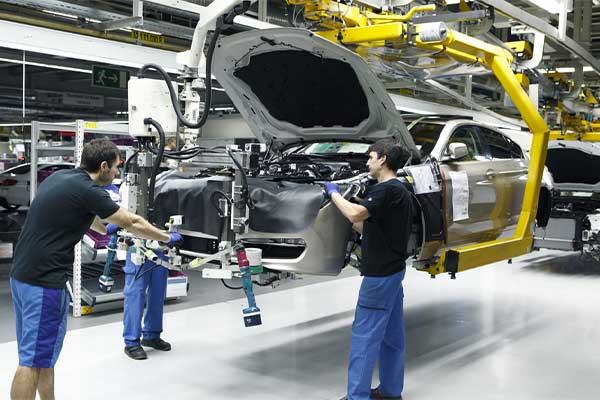
Automotive Industry
The manipulators of welding, sometimes called column and boom, have a critical role in such an automotive industry because of the way the operation principles work.
Higher accuracy and reproducibility
It is so important to have really exact welding. Automation ensures that each weld has been reproduced without the possibility of failure, therefore increasing the quality of cars.
Increased Speed of Production
With partial automation of welding by the manipulators, speed is greater compared to manual human welders. This speed aspect is very important in the industry as it needs to run out high volumes of vehicles efficiently.
Safety Improvement
Welding is a dangerous process requiring extremely high temperatures and flashes that are potentially damaging to the eyes of human operators. Manipulators help the industry reduce these chances, as it is actually carried out by the machine itself and the operators can oversee the process from relatively safer distances.
Flexibility
This is whereby manipulators for welding can be readjusted and customized for handling varied jobs. The equipment will, therefore, find use in welding various portions of a vehicle, such as the chassis or the frame. In addition, they are able to handle various welding techniques, and this is quite convenient in an industry that uses varying materials and methods of joining.
Reduced Labour Cost
Though these machines require a high amount of investment in the beginning, they reduce the requirement number of welders on a production line thus reducing the labor cost in the long run.
Pipe Welding
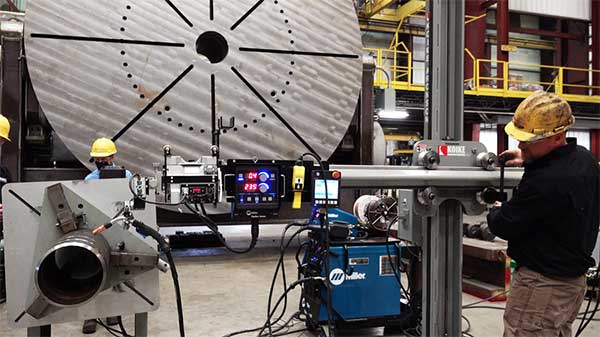
Pipe Welding
Column and boom systems play a very important role in pipe welding in a variety of ways. Here is how they are generally applied:
Positioning
It is capable of positioning the head of welding with great accuracy, hence, resulting in reproducible welds through the complete circumference of a pipe. This is quite crucial where a big pipe is involved which cannot be turned or rotated with much ease.
Accessibility
Column and boom manipulators allow the welder to reach difficult areas of the workpiece. This is quite convenient in situations where pipes are installed in tight or complex configurations.
Efficiency
The welding process may be faster and more continuous when the manipulator is used. Because the welder can devote his efforts entirely to controlling the weld quality, there is no need to change manually the position of the equipment or the workpiece.
Consistency
These manipulators help in keeping a constant welding speed and distance from the weld joint, two very important factors in making perfect welds. In pipes, which quite often have to resist high pressures and temperatures, the welding needs to be consistent.
Safety
Such welding manipulators reduce the need to work in hazardous positions like great heights or cramped spaces. This reduces the chances of accidents and injuries.
Versatility
Many welding manipulators are suited for numerous kinds of welding processes, and several welding heads can be fitted, depending on what the particular job calls for.
Tank and Vessel Fabrication
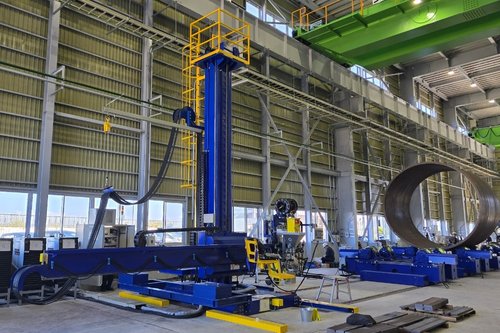
Tank and Vessel Fabrication
Some of the applications of welding manipulators in tank and vessel fabrication are listed below.
Versatile Positioning
This machinery allows the welding head to access several other parts of a tank or vessel, which might otherwise be impractical to reach. This is quite important since it ensures that all places in this structure get a good and even weld.
More Productivity
The manipulator contributes to quicker completion of tasks by welders. Hence, the system keeps moving the welding head continuously along the seams of tanks and vessels more smoothly and in less time than the actual setting-up and adjustment of welding equipment.
Consistency
It is among the major keys to structural integrity for tanks and vessels, many of which come into contact with liquids or gases under pressure. Manipulators in welding help maintain a uniform speed with a steady hand, hence higher quality and fewer defects.
Safety Ensured
Manipulators lessen the risk involved in welding big tanks and vessels. Welders will not have to work in hazardous positions, like on top of large structures or inside confined areas.
Reduced Fatigue
Large structure welding can be very exhausting at times. The manipulator may take up much heavy lifting and precise movements to burden welders so that they may concentrate on the welding process without any physical strain.
Customization
Most of the welding manipulators are designed in such a way that they can address various types of welds and angles. It is a very useful trait in customized tank and vessel fabrication where every project might have specific needs that are different from others.
Heavy Machinery Production
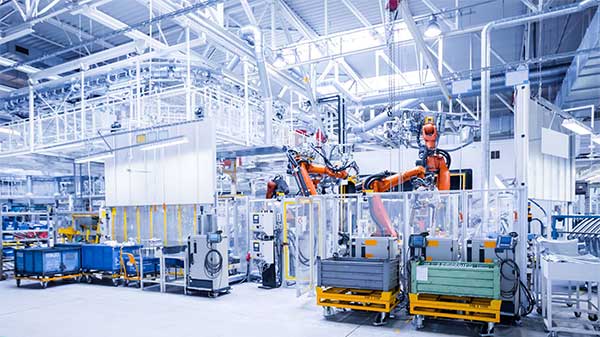
Heavy Machinery Production
Such devices serve to handle and manage the welding process by making it more efficient and even safer.
The following describes a simple breakdown of their role:
Reach and Accuracy
Having a column and a boom structure also allows the welding equipment to reach several different parts of big machinery without having to move the heavy components themselves. This is highly beneficial when someone is welding on large objects, like tractors, cranes, or mining equipment.
Consistency
As these manipulators can traverse along their patterns with such a lot of precision, the welding can be uniform at different parts of the machinery. This is very crucial in terms of sustaining the strength and quality of the final product.
Speed
These manipulators can speed up the production time because there is partial automation in the welding process. They can work without a resting period and this, in itself, is a big advantage over manual welding.
Safety Provider
Welding involves high heat and bright flashes that may be hazardous. The manipulators keep workers further away from the direct operations of welding at a safer distance, hence reducing the risk of injuries.
Versatility
They can be fitted out with various welding tools and adjusted to work on different angles and heights; therefore, their use is quite versatile for multiple kinds of welding jobs in heavy machinery production.
Railroad Construction
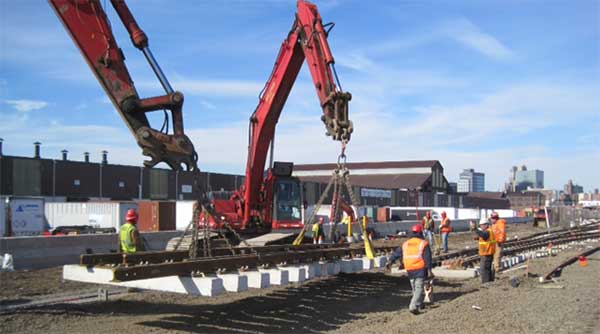
Railroad Construction
They, in their own many ways, contribute to the building and maintenance of railways:
Tracking Construction and Repair
The manipulators are able to weld long stretches of railroad tracks with a great deal of precision, often very consistently. They make the welds strong and uniform, something very important in safeguarding and enlarging the life span of railway lines.
Fabrication of bridges
Most railroad bridges involve much metalwork, and welding manipulators play a significant part in fabricating and repairing such huge metal structures. Handling heavy components and reaching difficult spots, they increase the speed and safety of the construction process.
Material handling
Efficient material handling can be considered as one of the main challenges of handling large metal beams and other structural components in every railroad construction. Welding manipulators move and place heavy items at precise, accurate, and specific positions, reducing the physical demand on employees and avoiding construction mistakes.
Productivity
It enhances productivity through automation in welding, hence increasing the speed that involves a construction process. They can therefore work continuously, laying or repairing more tracks in less time compared to manual methods.
Improved Safety
Rail construction sites are hazardous, and with the high heat and sparks arising from welding, there is an element of associated risks too. The manipulators reduce the level of exposure that workers have to the welding process, hence making the site a little safer.
Nuclear and Thermal Power Plants
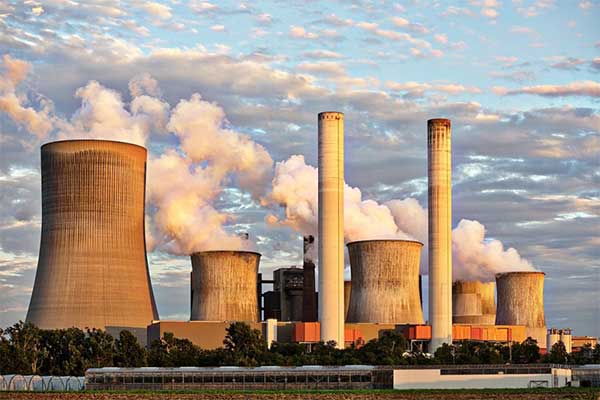
Nuclear and Thermal Power Plant
Following are key ways in which the welding manipulators apply:
Precision in Critical Components
The accuracy of welding in power plants, especially in nuclear plants, plays a very important role in respect to the safety concern. Manipulators for welding provide very accurate welds according to strict regulatory standards so that critical components such as pressure vessels and reactors are constructed with safety.
Convenience
Large and heavy parts are common in power plants. Obviously, it is quite inconvenient to handle large parts manually, and meanwhile, they bear different kinds of hazards; in place of this, the welding manipulators can position such parts easily and carry out the welding work with much ease and efficiency.
Improved Safety
Nuclear and thermal power plants expose their workers to many hazardous situations. Welding manipulators reduce human exposure in the direct welding activity, therefore reducing accidents associated with high heat, radiation, and fumes from metals.
Durability and Quality Assurance
The power plants need durable welds that are precise and should stand up in extreme conditions for quite a period. Manipulators help to realize consistent, high-quality welds that will be important in long-term operations and safety of the plants.
Efficiency in Construction and Maintenance
The machines can work continuously without stopping and do the same repetitive jobs without any fatigue. This has indeed given tremendous gain in speed for constructing and maintenance works, both being benefited in this regard. This efficiency becomes a matter of prime importance in the case of minimizing total downtime of production during shutdowns, especially at periods of critical maintenance.
Conclusion
From heavy machinery production to the building of railroads, welding manipulators can be applied to a wide range of industries. Welding manipulators play an important role in enhancing efficiency, safety, and quality in the welding process.
They quicken the manufacturing process of large-sized machinery with high precision and consistency in the heavy machinery production process. In railway construction, they accelerate the laying of tracks and fabrication of bridges, making the work more productive while ensuring the safety of the workers.
Moreover, in critical environments within nuclear and thermal power plants, machinery plays the primary role in granting high-quality standards in order to ensure durability and safety of main structures.
Everything is based on the choice of appropriate equipment when it comes to business and raising the level of welding. One of the leading companies that offer advanced welding positioners and manipulators is SENLIS WELD. Equipped with advanced technology, customer-centric support, and excellence in service, we are the ideal partner for providing solutions to your specialized welding requirements.
Choose correctly as you scale up your operations to the next level with SENLIS WELD-precision meets reliability. To learn more about how our solutions can enhance your production efficiency and safety, please do not hesitate to contact us today.
FAQs
How does the welding manipulator improve safety within nuclear power plant operations?
Welding manipulators increase nuclear power plant safety in that they can automate the welding process. This lessens the need for human operators to approach the dangerous conditions of radiation and high heat, thus providing constant, accurate welds that are essential for safety and integrity within critical infrastructure.
What are the advantages that welding manipulators can offer for heavy machinery construction?
In the manufacture of heavy machinery, welding manipulators provide advantages of long reach, precision, and ease of handling large components. This greatly enhances the quality and consistency of welds but also offers dramatic reductions in production times, thereby reducing labor costs and enhancing general manufacturing efficiency.
Is it possible to use welding manipulators to weld railroad tracks outdoors?
Yes, welding manipulators can effectively be used for outdoor railroad track welding. They are essentially useful for their precision and consistency in producing high-quality welds over long stretches of track, an important capability in the maintenance of durable and safe railroad infrastructure.
Does the welding manipulator suit every type of welding process applied in thermal power plants?
The manipulators also have provisions for handling different welding processes, like TIG, MIG, and arc welding required in various applications of thermal power plants. Due to this versatility, they can be deployed on a wide range of applications within the plant, starting from boiler construction to pipeline repair, with high-quality welds that are guaranteed to meet the standards of the industry.
What features should one look out for when choosing a welding manipulator meant for heavy industrial applications?
Selection criteria for a welding manipulator used in heavy industrial applications would include system load capacity, reach, and flexibility, plus the type of welding the system will support. Productivity and safety-enhancing options would also include programmable memory settings to operate the manipulator for repetitive tasks, remote operation of the manipulator, and the ability to interface with existing automation systems.


 EN
 ES
 RU
 JA
 FR
 PT